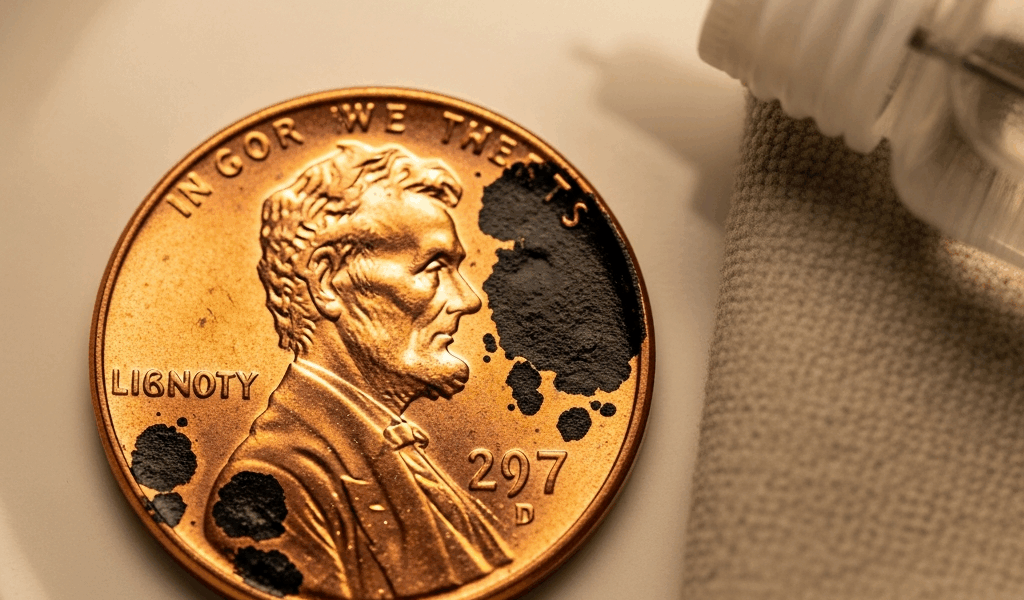
Why Your Lincoln Cent Has Black Spots After Cleaning
Coin cleaning has gotten complicated with all the contradictory advice flying around. Vinegar, baking soda, toothpaste — everyone online has a different miracle method. And then you try one, your cent looks amazing for about two hours, and then the black spots show up.
As someone who’s been collecting seriously for eight years, I learned everything there is to know about this particular disaster firsthand. A 1944 wheat cent from an estate sale — paid $4 for it, thought I’d clean it up, make it shine. Instead I turned it into a chemistry experiment I couldn’t undo. Today, I will share it all with you, including what those spots actually are, whether yours are salvageable, and how to stop the damage right now.
What Those Black Spots Actually Are
But what are black spots on a cleaned cent, chemically speaking? In essence, they’re copper oxides and sulfides forming on newly exposed metal. But it’s much more than that.
Lincoln cents minted before 1982 are 95% copper. Copper is reactive — it doesn’t just sit there quietly. Expose it to oxygen, moisture, or sulfur compounds and it starts forming dark compounds almost immediately. That’s what you’re looking at. Not dirt. Not residue. A chemical reaction happening in real time.
Here’s the part that changes everything: before you cleaned it, your coin had a protective layer. Natural patina — that warm brown or reddish tone that develops over decades — actually shields the copper underneath from further oxidation. You removed that shield. Now bare metal is sitting exposed, and if there’s any moisture, any mineral residue, any acidic film left from your cleaning method, the copper oxidizes fast. Within hours. The spots tend to appear first in the recesses — the lettering, the date, the wheat stalks on the reverse — because that’s where residue collects and dries last.
Tap water makes it worse. It carries minerals and sometimes chlorine. Acidic cleaners like vinegar or lemon juice keep working on the metal long after you’ve rinsed — at least if you didn’t rinse thoroughly enough. Even cloth fibers caught in the design can trap moisture and create tiny isolated oxidation pockets. The difference between reversible and permanent comes down to depth. Light gray or uneven brown discoloration might be surface-level. True black spots that look slightly sunken? That’s pitting. The copper itself has been eaten away. That’s permanent.
The Most Common Cleaning Mistakes That Cause This
Vague warnings don’t help anyone, so let’s be specific.
Vinegar without a thorough rinse is probably the biggest culprit. Acetic acid dissolves dirt and green corrosion effectively — but soak a cent in 5% white vinegar for twenty minutes and rinse it once under the tap, and you’ve left acid residue on the surface. It keeps working. I’ve watched black spots appear on a cent left to air dry on a paper towel after a vinegar soak — the towel itself held moisture against the coin while the acid kept oxidizing the copper underneath.
Drying technique is the second major mistake. Cotton cloths, paper towels, even microfiber — all of them can leave fibers embedded in the design, especially in deep letters and the coin’s reeding. Those fibers absorb ambient moisture from the air. Moisture causes oxidation. You end up with black spots arranged in a pattern that mirrors exactly where the cloth fibers stuck. I’m apparently a slow learner on this one, and paper towels work for drying dishes while they never work for coins.
Third: baking soda paste that isn’t completely removed. Gentler than vinegar, yes. But paste that dries in the recesses hardens there. It traps moisture underneath. Don’t make my mistake — I did this to a 1941-D cent, used baking soda paste, didn’t rinse the recesses of Lincoln’s coat thoroughly enough. The black spots formed under the dried paste. They’re still there.
All three share the same pattern. Cleaning agent goes on, doesn’t come completely off, creates an environment where oxidation accelerates. That’s the whole story.
How to Tell If the Damage Is Reversible
Probably should have opened with this section, honestly.
Get a loupe — a 10x magnifier runs about $8 to $15 on Amazon, the Dreame brand ones work fine. Look at the spots closely. Light gray or brownish, sitting on top of the surface? That might be early-stage oxidation. Not pretty, but potentially stabilizable. True black, slightly sunken into the metal, rough or textured under your fingernail? That’s pitting. The copper is gone. It’s not coming back.
Location matters. A few black spots on a worn 1944 wheat cent — bad, but the coin was already circulated and had existing value loss. Black pitting on a proof cent or a key-date Lincoln like a 1909-S VDB? That coin’s collector value was built entirely on its original surface. Post-cleaning pitting destroys that completely.
Be honest with yourself. If more than 20% of the visible surface shows true black spots, the damage is permanent and the numismatic value is gone. That’s what it is. Accept it and learn from it.
What You Can Do Right Now to Stop It Getting Worse
- Rinse the coin in distilled water — not tap water — for at least 30 seconds under a gentle stream. The kind you’d buy for a humidifier, around $1.50 a gallon at any grocery store.
- If you used vinegar or any acidic cleaner, rinse twice. Thirty seconds each time.
- Pat dry gently with a soft, lint-free cloth. Pat. Don’t rub.
- Place the coin face-up on a clean soft surface and let it air dry for at least two hours somewhere with low humidity — not the bathroom, not near the kitchen.
- Once it’s completely dry, put it in a non-PVC holder. A cardboard 2×2 flip works, or a Saflip polyester holder. Non-PVC is critical — PVC offgasses acids over time and will cause more oxidation. That’s why old soft plastic flips turn coins green.
- Store it somewhere cool, dry, and away from direct sunlight.
No additional cleaners. No coatings. No “coin dips.” The goal now is to stop the process entirely, not restart it with something new.
When to Accept the Loss and Move On
Over-cleaned Lincoln cents almost never recover collector value. A 1909-S VDB with black pitting from cleaning might bring $200 at auction. The same coin with original patina — even circulated — might bring $800 or more. That’s the reality of numismatics. The market punishes cleaned coins hard.
But here’s the thing. Every serious collector has a cleaned coin story. I have at least four. The 1944 wheat cent. The 1941-D. A Buffalo nickel I’d rather not discuss. They’re learning experiences — at least if you actually learn from them.
That’s what makes the hobby endearing to us collectors, honestly. You learn this stuff the hard way, on coins that matter to you, and then you never forget it. Store your damaged cent properly anyway. Keep it as a reminder. And when you find the next old coin, you’ll know exactly what to do — which is mostly to leave it alone.

Stay in the loop
Get the latest collectors coin corner updates delivered to your inbox.