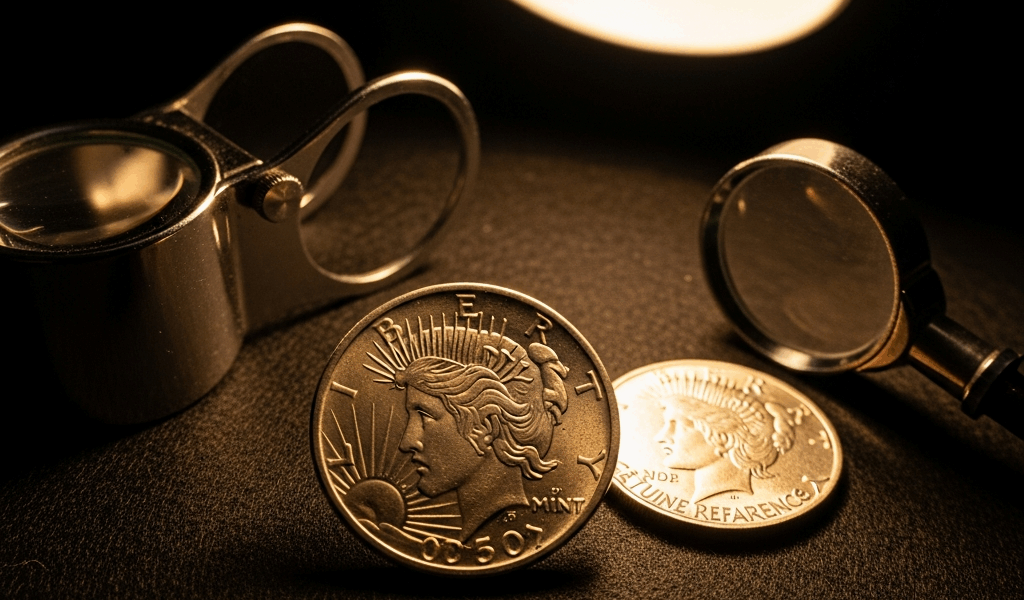
Why Peace Dollars Keep Attracting Fakes
Peace Dollar collecting has gotten complicated with all the counterfeits flying around. And honestly? The math explains everything. A genuine 1921 Peace Dollar in decent shape sells for $200 to $400. The 1928 runs $300 to $600. A 1934-S pulls $1,500 to $2,000 depending on grade. Those are not small numbers.
So around 2010, Chinese manufacturers started flooding eBay, Craigslist, and a handful of less-reputable dealers with convincing replicas. The coins are common enough that buyers drop their guard — you spot a Peace Dollar at $150 when the real one costs $400, and your brain screams “deal.” That is exactly the trap. Your mailbox fills with buy-my-collection offers for the same reason.
The problem is that Peace Dollars look deceptively simple to fake. No security features. No holograms. Just a woman’s profile on one side, an eagle on the other. A decent mold and some basic casting technique gets you 80 percent of the way there. The remaining 20 percent — the details that separate real from replica — that is what we are hunting today. So, without further ado, let’s dive in.
Start With Weight and Diameter — Your First Filter
Every genuine Peace Dollar weighs exactly 26.73 grams and measures 38.1 millimeters across. Not approximate. That is the spec, full stop.
Get a digital scale. I use a Gemoro AWS-100 that cost me $18 on Amazon two years ago. Any jewelry-rated scale works fine — you need accuracy to at least one decimal place. Same story with calipers. A basic digital caliper from Harbor Freight runs about $12 and gives you 0.1-millimeter precision. These are tools you probably already own if you have been collecting longer than a year.
Probably should have opened with this section, honestly. Here is the practical move before anything else: weigh a known genuine Peace Dollar first. This calibrates your expectations. Your scale might read 26.7 or 26.8 instead of exactly 26.73 depending on that unit’s tolerance — knowing your baseline matters. I made the mistake early on of flagging a coin as fake because it read 26.6, then realized my scale ran 0.1 grams light consistently. Don’t make my mistake.
Most counterfeits come in lighter. Not always, but often enough. Casting does not pack metal density the way a coin press does. You will see readings of 25.8, 26.1, 26.4. Red flags, all of them.
Diameter is actually easier to check. Fakes frequently run 37.8 to 38.5 millimeters instead of the exact 38.1. Coin fails both tests? You have your answer. Coin passes both? You passed round one. Nothing more.
What to Do When the Numbers Check Out
Passing weight and diameter means you eliminated the crudest fakes. It does not mean you have a real coin. Move forward. Do not congratulate yourself yet — the harder part is next.
Reading the Details Fakers Almost Always Get Wrong
This is where you actually look at the thing. Grab a 5x loupe minimum — I prefer a 10x Bausch & Lomb for this kind of work, picked one up for $14 on eBay. Get good light. Natural sunlight beats artificial every single time.
Start with Liberty’s hair. On a real Peace Dollar, the strands are fine, distinct, with gradual transitions from thick relief to thin. The engraver cut these with clear intention. Counterfeits — especially cast fakes — show mushy hair. Strands blur together. Transitions are either too abrupt or too soft. You are hunting sharp, deliberate lines.
Move to the reverse next. The eagle’s wing feathers on a genuine coin have real texture — each feather holds definition. Cast counterfeits flatten all of that. Feathers become wavy lines instead of carved details. This is the single most visible tell on Peace Dollars. The eagle work separates real from fake faster than anything else on the coin.
Check the date numerals. On genuine coins, font weight stays consistent — the “1” is thin and clean, the “9” shows uniform thickness throughout. Counterfeits often show irregular font weight because the mold degraded or was sloppy from the start. A “2” fatter than a “1” on the same coin? That should never happen. Never.
But what is relief depth, exactly? In essence, it is how high the design elements rise off the coin’s flat field. But it is much more than that. Genuine Peace Dollars carry a specific softness at their highest points — not lost definition, but a gentleness that comes from metal yielding to the die under enormous pressure. Cast fakes either go too hard and sharp (fresh mold) or muddy and worn (mold degraded after a dozen pours). Real coins hit a middle ground that is genuinely hard to describe but obvious the moment you see it beside a known genuine example.
The reeded edge matters too. Peace Dollars carry a rim of tiny vertical ridges. On counterfeits, this reeding often runs flat, inconsistent, or disappears in sections. Run your fingernail slowly across the edge. A real coin has distinct, regular ridges. A fake usually feels smooth or uneven. That five-second check has saved me three times.
The Ping Test and What It Actually Tells You
Balance the coin on your index fingertip. Tap it with another coin — a pencil works too, though metal on metal is better. Listen.
Real silver rings. Not a tiny ting. A sustained, clear ring lasting two to three full seconds. Bright, almost musical. Base metal counterfeits thud. Dull, dead, over immediately.
There is an app called Coin Zip that records frequency and analyzes it, but your ear handles this fine without any technology. Listen to a confirmed real Peace Dollar first, then test your suspect coin. The difference is immediate — no training required.
Is this test foolproof? Not quite. Silver-plated counterfeits ring because there is real silver on the surface. Some brass fakes ring decently depending on their thickness. This is one tool in your kit, not the final verdict. It catches most crude fakes and tells you whether to keep going or stop right there.
When to Stop Guessing and Get It Slabbed
Here is the honest part. If you are looking at a 1921, 1928, or 1934-S — and that coin is worth more than $300 — stop testing at home. Submit it to PCGS or NGC. Full stop.
I apparently kept avoiding this step for two years because grading fees seemed expensive and the wait annoyed me. I was wrong. A $30 grading fee is trivial insurance on a $500 coin. Authentication is definitive. The holder protects the coin. The grade adds real marketability when you go to sell.
The process is straightforward. Head to PCGS.com or NGCcoin.com. Create an account. Order a grading kit — it ships free. Pack your coin carefully in the provided flip, fill out the submission form, include payment, and mail it in. Standard service runs six to eight weeks. Fees land between $20 and $50 for coins in the Peace Dollar value range, based on declared value. What comes back is an expert verdict inside a sonically-sealed slab.
For coins under $300, your at-home checks are reasonable. Weight, diameter, visual detail, and the ring test together give solid confidence. For anything higher — or for the known high-counterfeiting dates regardless of price — submit it. That is not optional advice.
One practical rule that has never failed me: if the deal feels too good, it is too good. A Peace Dollar priced 30 percent below market on Facebook Marketplace is not a bargain. It is a warning. That $30 grading fee looks very cheap compared to eating a $400 loss on a convincing fake you later cannot move. That is what makes authentication endearing to us collectors — it removes the guesswork entirely.


Stay in the loop
Get the latest collectors coin corner updates delivered to your inbox.