How to Remove Toning From Coins Without Damage
Eight years into serious coin collecting, I’ve made every mistake in the book when it comes to toning removal. I’ve watched friends tank the value of genuinely rare coins by reaching for the wrong cleaning supplies — materials they thought were safe but absolutely weren’t. The frustration is real: you find a beautiful 1921 Morgan dollar at an estate sale, but it’s buried under a gray-blue patina that makes you wonder what’s underneath. You search for how to remove toning from coins without damage, and you find conflicting advice everywhere. One forum swears by lemon juice. Another warns you’ll destroy the coin entirely. So, without further ado, let me share what I’ve actually learned works versus what destroys numismatic value in minutes.
The truth is messier than most advice suggests. Some toning genuinely deserves removal. Some shouldn’t be touched at all. And there’s an enormous gap between “safe” and “actually recommended by grading companies.”
Why Toning Develops on Your Coins
Toning happens because coins are made of metals that oxidize. Silver especially reacts to sulfur compounds in the air, in storage materials, and sometimes in soil where coins have been buried for decades. A Morgan dollar sitting in a PVC-laden holder from the 1970s develops that characteristic green or blue toning — a chemical reaction between silver and the vinyl chloride breaking down over time.
Here’s what makes this complicated: not all toning is created equal.
Rainbow toning on a silver dollar — those swirling purples, golds, and blues — actually increases value for many collectors. A 1881-S Morgan with natural, even rainbow toning might sell for 20–30% more than the same coin in untoned white condition. I picked up a toned Peace dollar last year specifically because the color was stunning. The dealer who sold it to me would have received less money if he’d cleaned it.
Undesirable toning is different. Dark spotting, uneven haze, or that gray-green film from poor storage — these detract from eye appeal without adding collector premium. This is where removal actually makes sense.
The chemistry is straightforward: oxidation. Silver is reactive. Sulfur and other atmospheric compounds accelerate the process. Humidity, temperature swings, and inferior storage containers speed it up dramatically. A coin stored in acid-free 2x2s with silica gel packets will tone far more slowly than one left loose in a cardboard box in a humid climate.
When You Should NOT Remove Toning
Probably should have opened with this section, honestly.
I watched someone at a coin show clean an otherwise pristine 1894-S Barber dime with an old toothbrush and distilled water. Just light toning — nothing dramatic. They wanted it to look “fresh.” That dime was a $3,200 coin in AU details with original toning. After the cleaning, a PCGS grader slabbed it at $1,100 because the removal itself constituted damage to the original surface. That collector learned this lesson the hard way.
Here’s why professional grading companies penalize cleaned coins so heavily: once you remove toning, you’ve altered the original surface permanently. Serious collectors — the ones with actual money — specifically seek original surfaces. The premium for original toning, especially on early silver dollars and rare dates, is substantial.
If your coin has any of these characteristics:
- Even, natural-looking toning in rainbow hues
- Original owner provenance with the patina intact
- High value and rare date status
- Any toning on a coin already in the $1,000+ range
Leave it alone. Hire a professional conservator if you’re concerned about preservation, but don’t attempt removal yourself.
I made the mistake of cleaning a BU Morgan with heavy, dark toning once. I thought I was improving it. I wasn’t. The coin dropped two grades in value, and PCGS noted “cleaning” in the label comments. That coin will never recover that premium.
Safe Removal Methods for Common Toning Types
If you’ve decided removal is actually necessary — and you’ve honestly evaluated whether your coin’s value will improve — here are the gentlest techniques that collectors have used successfully.
Distilled Water Soaks
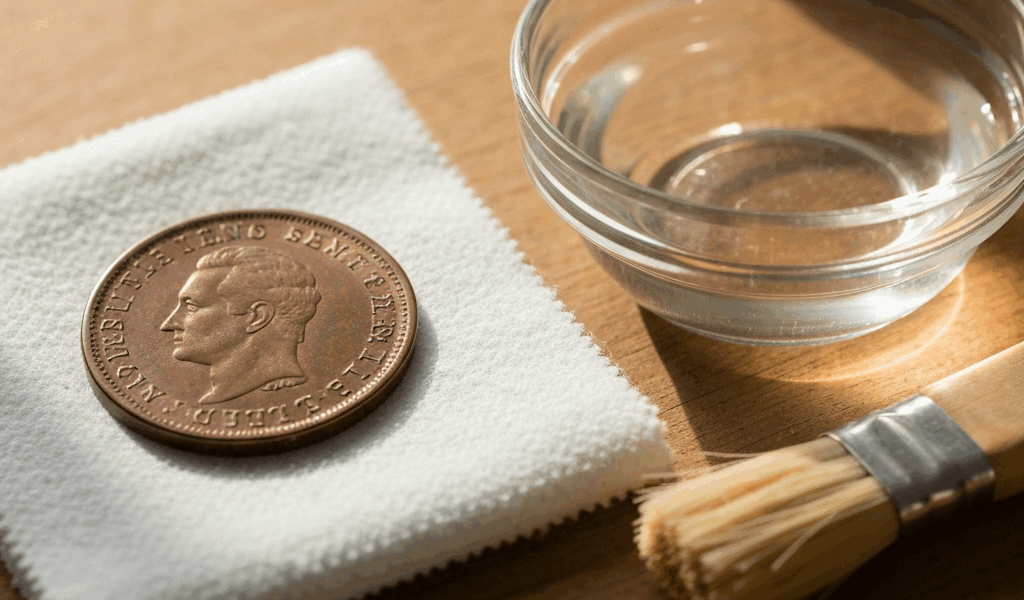
Start here. Soak the coin in distilled water (not tap water, which contains minerals that add new spotting) for 12–24 hours. Some light toning will simply lift off. I’ve had success with this on copper coins that developed green patina. The key is patience and gentleness. Don’t scrub. Just let chemistry and time work.
After soaking, remove the coin, let it air dry completely on a microfiber cloth, and examine the result. Often, this is enough.
Microfiber Cloth Method
Using a soft microfiber cloth — never terry cloth, cotton, or anything with texture — gently wipe the coin in one direction while it sits on a flat surface. No pressure. Think of it as barely touching the surface. This removes loosened oxidation without abrading the actual metal. I use 99.5% pure microfiber jewelry cloths that cost about $3–5 for a pack of three at any jewelry supply store.
This works best on light, surface-level toning. Expect modest results on coins with decades of accumulation.
Acetone — With Serious Caveats
This one gets debated constantly among serious collectors. Pure acetone (100%, not nail polish remover) can dissolve some organic compounds sitting on coin surfaces. Some collectors use it with limited success on stubborn toning.
But here’s why I hesitate: acetone is harsh. It can strip protective patinas that actually preserve the underlying metal. It can leave residue. Use too much or leave the coin sitting too long, and you risk damage that looks similar to actual cleaning. Professional conservators avoid it for these reasons.
If you go this route — which I don’t recommend for valuable coins — use minimal acetone on a cloth, wipe gently, and rinse immediately with distilled water. Dry completely within minutes. One pass. That’s it.
What NOT to Use
Do not use any of these:
- Vinegar or lemon juice (acidic solutions etch the surface)
- Baking soda or toothpaste (abrasive particles damage the patina)
- Harsh commercial coin cleaners (formulated to remove oxidation aggressively)
- Ultrasonic cleaners (vibrations cause hairline scratches)
- Wire brushes or metal polishing compounds
- Anything containing PVC or chlorides (introduces new patina)
I’ve seen people use Bar Keeper’s Friend on coins. Never do this. Ever. The abrasive action will visibly damage the surface in seconds.
Signs Your Toning Removal Went Wrong
If you’ve already attempted removal, here’s how to spot whether you’ve caused damage.
Hairline scratches that weren’t there before indicate you used too much pressure or an abrasive medium. These are visible under light at certain angles and will lower the coin’s grade immediately. There’s no fixing this — the damage is permanent.
An uneven finish is another red flag. If one side looks matte and the other still has its original luster, you’ve removed the protective patina unevenly. Professional graders will note this.
Spotting or white residue where toning used to be suggests incomplete rinsing or a chemical reaction that occurred during cleaning. This looks worse than the original toning and is difficult to reverse.
Any visible wear pattern inconsistent with natural circulation is a problem. If the high points suddenly look shiny and the fields look matted — or vice versa — you’ve interfered with the original surface.
When to Send Your Coin to a Professional
There’s a threshold where DIY becomes risky. If your coin is worth more than $500, has a rare date, or carries significant sentimental value, professional conservation is the investment you should make.
Numismatic conservators — not coin “cleaners,” these are different — use stabilization techniques that preserve original toning while preventing further oxidation. They work under magnification. They understand the difference between conservation (safe, reversible) and restoration (permanent alteration). Companies like Numismatic Conservation Services or individual conservators certified by the American Numismatic Association will actually preserve your coin’s integrity.
Yes, it costs money. Professional conservation runs $50–200+ per coin depending on complexity. But if you’re removing toning from a $2,000 Morgan, paying $100 for professional work preserves the coin’s authenticity far better than risking a DIY mistake that drops its grade.
The decision tree is simple: Is the coin worth more than the cost of professional conservation? If yes, hire a conservator. If no, accept the toning or attempt gentle methods only. Don’t risk the middle ground with your most valuable pieces.


Stay in the loop
Get the latest collectors coin corner updates delivered to your inbox.