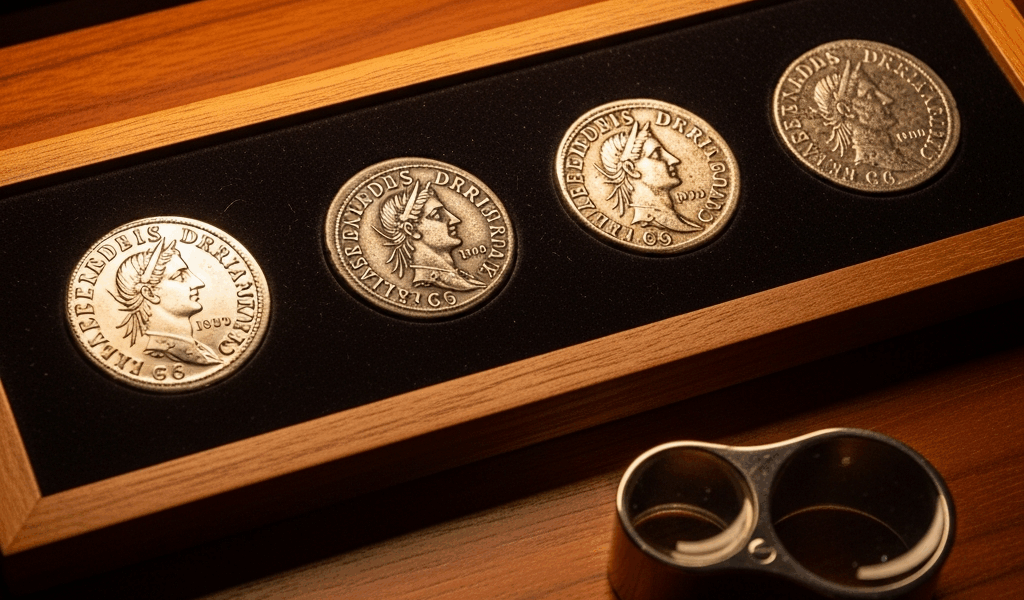
Why Coin Grades Matter More Than Most Beginners Think
Coin collecting has gotten complicated with all the jargon flying around. I bought a Morgan dollar at a coin show for $120 because the dealer said it was “MS63.” Looked great to me. Got it home, found the same coin listed online for $35 raw, and realized I’d completely confused “Mint State” with actual condition. That was a painful Tuesday. That’s when I learned what coin grades actually mean — and why they’re not optional knowledge if you plan to spend real money on this hobby.
But what is a coin grade? In essence, it’s a standardized number that describes a coin’s physical condition. But it’s much more than that — it’s the difference between paying $40 and paying $400 for what looks like the same piece of silver. The Sheldon scale runs from 1 to 70, created back in the 1940s by a numismatist named William Sheldon. Poor coins sit at 1. Perfect, never-touched coins hit 70. Everything in between is where real collector decisions happen.
Today, I will share it all with you. By the end of this article, you won’t need a PhD in numismatics to understand what MS63 means, or why an EF45 sometimes looks better than an MS60, or whether that metal detecting find deserves a professional slab. Grades are a practical tool. They should feel like one. So, without further ado, let’s dive in.
The Four Big Grade Tiers and What They Really Mean
The 70-point scale sounds intimidating. It isn’t. Collectors really operate inside four territories, and breaking it down that way helps enormously.
Poor to Fine — Grades 1 to 12
These coins have seen real life. Heavy wear covers most of the design. High relief points — the cheeks on a portrait, the hair, the shoulders — are smooth and flat, ground down by thousands of hands over decades. Rims are sometimes worn to nothing. These coins cost what they cost because they’re old, not because they’re pretty. Most collectors skip this tier entirely unless they’re hunting a specific date or building a type set on a tight budget. Nothing wrong with that approach, honestly.
Very Fine to Extremely Fine — Grades 20 to 45
This is where a huge number of coins land. High relief points show wear, but the design is still there. Hair strands are visible. Lettering is clear and sharp. The coin has a story written into its surface, which is exactly what makes circulated coins endearing to us collectors.
An EF45 Morgan dollar might run $40 to $60 right now. It’ll sit in your collection for decades and look respectable. Nobody mistakes it for new — but that’s not the point. The point is you own a piece of 19th century American commerce that actually worked for a living.
About Uncirculated — Grades 50 to 58
AU coins barely made it into circulation. Maybe a handful of people handled them before they disappeared into a drawer somewhere. The difference between AU50 and AU58 is subtle — AU50 has light friction on the high points, while AU58 looks nearly untouched except under magnification. Prices jump noticeably here. An AU58 coin sometimes costs $100 more than an EF45 for the same date and mint mark. Worth it? Depends entirely on whether you care about that last sliver of originality.
This is also where beginners get confused. An AU58 can legitimately look better than an MS60 coin. I’ll explain why in a minute.
Mint State — Grades 60 to 70
Mint State means the coin never circulated. It went from the die into a bag and stayed there until someone pulled it out. MS60 through MS62 are lower Mint State — obvious bag marks, contact damage from sitting in canvas bank bags for decades. MS63 and MS65 are commercial Mint State, the coins you typically see slabbed at shows. MS66 and above get expensive fast. MS68 and above are rare enough that the price jump between single grade points can be thousands of dollars.
An MS63 Morgan has noticeable marks. You’ll see them at arm’s length — small dings, bag contact, minor abrasions. But the luster, that original mint cartwheel shine, is mostly intact. An MS65 looks nearly flawless unless you’re hunting hard under a loupe. Price difference between MS63 and MS65 on the same date can be 300 to 500 percent. That’s not a typo.
The Grades That Trip Up New Collectors Most
Probably should have opened with this section, honestly. These confusion points cost people real money constantly — including me, that Tuesday in 2019.
AU58 vs. MS60 — The Invisible Line
This is the hardest boundary on the entire scale. AU58 coins haven’t circulated. MS60 coins haven’t circulated either. The difference is microscopic friction on the high points from metal-to-metal contact inside a canvas bag. An MS60 coin can look genuinely worse than an AU58 coin. Dealers know this. Many buyers don’t.
Real talk: if you’re at a show and someone’s offering an AU58 and an MS60 of the same date side by side, and the AU58 looks glossier and sharper — buy the AU58. Don’t let the label override your eyes. Don’t make my mistake.
MS63 vs. MS65 — Where the Price Explodes
MS63 coins have visible contact marks. Bag marks, small dings, surface abrasions on the high points. MS65 coins look pristine at casual glance. The price gap is enormous — sometimes 3 to 5 times higher for MS65. Is it three times more beautiful? Not really. But it’s scarcer, and scarcity drives value in this hobby whether we like it or not.
MS63 might be the best option for most collectors, as enjoyment-focused collecting requires visual appeal without financial agony. That is because MS63 coins look good, cost reasonably, and won’t sting badly if you sell later. I’m apparently an MS63 collector at heart and that approach works for me while chasing MS65 grades never quite did.
Why EF45 Sometimes Looks Nicer Than MS60
This happens because an EF45 coin might have been stored carefully in a dresser drawer for a hundred years, while an MS60 coin sat in a canvas bank bag getting tumbled with 999 other coins. The EF45 has circulation wear that smoothed it evenly over time. The MS60 has chaotic bag marks, weird contact damage, and lost luster in patches. The EF45 looks more attractive even though it technically got handled more during its working life.
Grading measures technical condition. Not visual appeal. These are not the same thing — and that distinction matters every time you open your wallet at a show.
How to Grade Coins You Find or Buy Without a Loupe
While you won’t need a $400 stereo microscope, you will need a handful of things: decent natural light, your naked eye, and about five minutes of patience per coin. That’s genuinely enough to get close.
First, you should start with the high relief points — at least if you want an accurate read. On a portrait coin, look at the cheeks, the hair curls, and the forehead. Smooth and flat means lower grade. Sharp and distinct means higher grade. On a Liberty head, check the hair detail and the shield. On a reverse, examine the eagle’s breast feathers and the wreath details.
Second, check the rim. A coin with a worn or damaged rim typically grades lower than one with a crisp, defined edge. Rim integrity tells you a lot about how that coin was stored and handled over its life.
Third, look at luster. Does the field — the flat background area — have that original cartwheel glow, or is it dull and scuffed? Luster fades with environmental exposure and handling. Strong luster almost always means higher grade.
Metal Detecting Finds Are Different
Frustrated by watching dug coins get dismissed at shows, I started learning how environmental wear differs from circulation wear. Coins pulled from soil grade differently than coins that circulated through normal commerce. Dirt contact and mineral oxidation leave marks that aren’t circulation wear in the traditional sense. An old Indian Head cent with heavy soil patina might grade VG8 despite spending most of its life underground rather than in someone’s pocket.
That’s okay. The Sheldon scale still applies. Get the coin lightly cleaned if needed — conserved, technically — let it stabilize for a few weeks, then grade it using the same standards. The scale is universal. This new understanding of environmental grading took off several years later among the detecting community and eventually evolved into the nuanced approach enthusiasts know and debate today.
When to Get a Coin Professionally Graded
PCGS and NGC are the two major grading services. Both examine coins under controlled lighting conditions, assign grades, and encapsulate them in slabs — hard plastic holders with a label sealed inside. The slab becomes third-party proof of grade. It matters to buyers who’ve never seen the coin before.
Does your coin need slabbing? Here’s a practical rule: if the estimated raw value exceeds $150, professional grading probably makes sense. Below that, raw coins sell just fine. Above that, a slab adds credibility and liquidity — especially if you’re selling online to strangers.
Slabbing costs $15 to $100+ depending on service tier and turnaround speed. Standard service at PCGS currently runs around 20 business days. Economy tiers take longer. Budget time accordingly before you commit that coin to a show table. Raw coins still have a massive, healthy market — don’t assume everything needs a slab to matter. Many serious collectors actually prefer raw coins, lower premiums and no plastic barrier between their fingers and the metal.
Your grading eye improves fast with practice. First attempts are usually off by 2 to 4 points. That’s normal. Buy a few reference coins — known, verified grades you can hold and study — and use those as anchor points for comparison. Your calibration tightens quickly. The Sheldon scale is a tool, not a mystery. Use it like one.

Stay in the loop
Get the latest collectors coin corner updates delivered to your inbox.