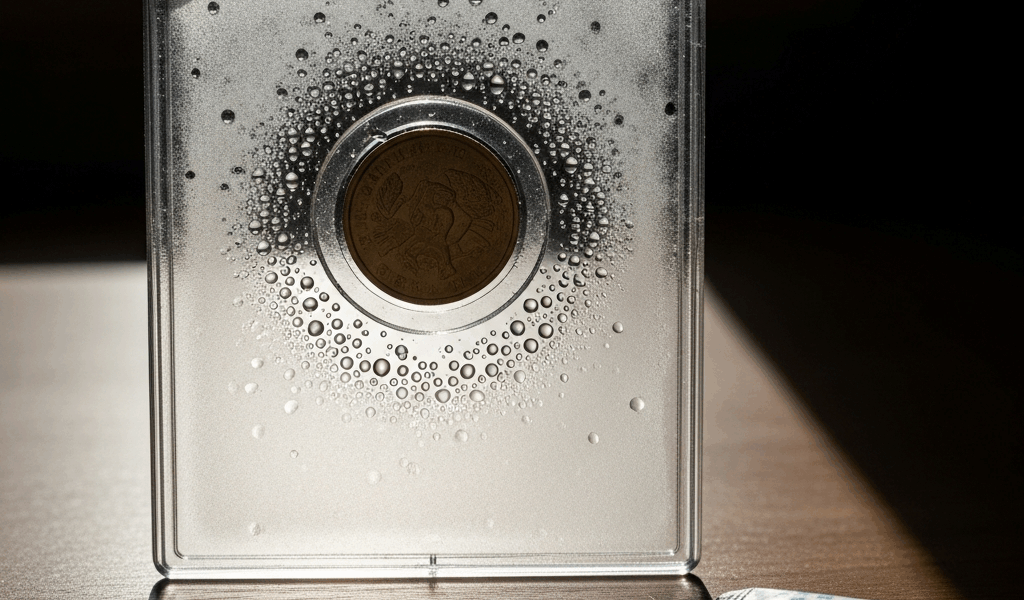
Why Your Encapsulated Coins Developed Condensation Inside
You bought that raw coin, had it graded during a humid July, and stored it in your basement. Now, months later, you pull the slab off the shelf and notice water droplets clinging to the inside of the plastic holder. Your stomach drops. Is your coin ruined? How did moisture get sealed inside an encapsulated slab in the first place?
As someone who’s spent the last eight years collecting certified coins—and who made every beginner mistake in the book—I’ve learned everything there is to know about why condensation forms inside slabs and what actually stops it. I’ve opened forums, messaged graders, and talked to dealers who handle thousands of slabbed coins annually. Today, I will share it all with you.
How Moisture Gets Trapped in Slabs
Condensation inside a slab happens because of three overlapping factors: humidity at encapsulation, microscopic air pockets in the holder itself, and temperature swings after you take it home. But what is condensation in this context? In essence, it’s water vapor that cools and becomes liquid inside a sealed container. But it’s much more than that—it’s a chain reaction that starts the moment your coin enters the grading facility.
Let me walk you through a real scenario. You ship a raw coin to a major grader—say, NGC or PCGS—in July. The grading room operates at around 50% relative humidity, but the moment your coin arrives at the facility, it’s been sitting in a padded envelope in a hot mailbox. The air around that coin is closer to 70% humidity. The graders work quickly, but they don’t wait for the coin to acclimate. Within hours, your coin is pressed into a plastic holder that, despite appearing airtight, contains microscopic gaps in its seams.
That moisture-laden air doesn’t escape. It’s now trapped at 70% humidity inside a sealed acrylic or polycarbonate slab.
Then you store the slab. If you live somewhere with seasonal temperature changes—say, 72°F in summer, 62°F in winter—the air inside the slab contracts and expands. When temperatures drop, that trapped air cools, and its capacity to hold moisture decreases. The result: condensation beads form on the inner surface of the plastic, clinging to the holder walls.
Probably should have opened with this section, honestly. Most collectors think slabs are hermetically sealed like a space suit. They’re not. The major graders have acknowledged this publicly — even NGC and PCGS, with decades of encapsulation experience and hundreds of millions of slabs in circulation, occasionally produce holders with interior moisture. It’s not common. I’d estimate less than 2% of slabs experience this issue, but it happens.
Basements accelerate the problem dramatically. If you store your collection in an unfinished basement, humidity often stays high year-round, typically 55–70%. A basement also experiences larger temperature swings than living spaces. In winter, you heat the main floor to 70°F while the basement stays 58°F. That 12-degree differential pulls moisture into the plastic enclosure like a sponge.
I learned this the hard way. Frustrated by limited shelf space upstairs, I stored a $2,800 certified 1921-S Morgan dollar in my basement’s built-in cabinet for eight months using basic cardboard storage boxes. Come March, I opened the cabinet to show a friend, and there it was: a thin fog coating the inner surface of the NGC slab. I panicked. I emailed NGC with photos and braced for the worst — selling the coin at a loss, resubmission costs, the works.
Spotting Condensation vs. Other Slab Issues
Before you assume you have condensation, confirm it. That’s what makes proper identification endearing to collectors who’ve panicked unnecessarily.
True condensation inside a slab shows specific visual markers. Water beads or droplets cling to the plastic holder — usually concentrated in one corner or along the bottom edge where gravity pulls moisture. If you tilt the slab slowly, those beads move. They’re liquid. Fogging or haze inside the slab that shifts position as you angle the holder is also condensation.
Dust or debris stays in place. If you tilt the slab and the speck doesn’t move, it’s probably trapped dust from the encapsulation process, not moisture. Tilt it five times. Ten times. The dust remains static.
Haze that doesn’t shift is more likely internal plastic clouding or manufacturing residue. The key difference: condensation is wet. You can sometimes see light reflecting off water droplets differently than off a dusty surface — that shimmer is your clue.
Run your finger along the outside of the slab. Does it feel damp? That’s not proof either way, but it’s worth noting for your documentation when you contact the grader.
Take a clear photo under bright LED light — I use a desk lamp positioned at 45 degrees — before contacting the grader. Photos matter because they create a record of the issue’s severity and location. Major graders receive claims about slab condensation weekly, and they take them seriously. But only if you can show visual evidence.
Is Your Coin Still Safe in the Slab
The honest answer: brief exposure to condensation is low-risk for most coins. Don’t open the slab yourself.
Modern certified slabs from NGC, PCGS, and other major graders use plastic enclosures with oxygen-blocking properties. The material itself is engineered to slow oxygen transfer significantly compared to old Lucite holders or PVC-heavy compounds. That means oxidation — the real threat to your coin’s surface — progresses far more slowly inside a certified slab than it would in open air.
If condensation has been visible for days or weeks, yes, there’s oxidation risk. Moisture accelerates patina formation on copper, speeds verdigris on silver, and can create new spots on otherwise pristine surfaces. But if you catch it quickly — say, within two weeks of first noticing it — the coin is almost certainly unharmed.
I can’t guarantee your coin will grade identically after moisture exposure. I can tell you that hundreds of collectors resubmit slabbed coins with condensation issues, and the vast majority receive the same grade or improve one grade point. That’s not zero-risk, but it’s reassuring.
The real issue isn’t the one month of moisture you’ve already had. It’s preventing months or years of it.
What to Do Right Now
Step one: Don’t crack open the slab. I know the instinct is strong. Resist it. Opening the slab yourself introduces far more oxygen and humidity than keeping it sealed — at least if you want to preserve any chance of a free replacement from the grader.
Step two: Contact the grading company with high-quality photos. Email works best because it creates documentation you can reference later. Include the holder’s label information — grade, date, certificate number — and explain when you first noticed the condensation. NGC and PCGS have separate departments for slab issues. Response times typically run 5–10 business days.
Step three: Understand what they’ll likely offer. Most major graders will replace the holder at no cost if condensation is verified and photographed. You mail the slab to them in a protective box (they may provide a prepaid label), they transfer your coin to a fresh slab, and you receive it back. The entire process takes 2–3 weeks and costs $0 beyond postage. Your original grade and certification number transfer to the new holder.
If the grader believes the condensation resulted from your storage conditions rather than a manufacturing defect, they may decline a free replacement but offer resubmission at standard rates — typically $20–$50 depending on the coin’s value. It’s a gray area.
Step four: If your coin is in an off-brand slab from a lesser-known grader, contact a local coin dealer. They can often facilitate recertification or advise whether opening the slab is justified. For coins under $200, professional recertification might not be economical, and keeping the coin sealed — condensation and all — may be the best move.
I waited 48 hours before emailing NGC about my Morgan dollar, and I regretted the delay. The longer you sit with visible condensation, the more uncertainty you live with. Email today. The grader’s response will clarify your next move — and honestly, it’s usually faster and easier than you’d expect.
How to Prevent This With Future Purchases
Storage is everything. Three rules matter most, and they’re not complicated.
First, maintain stable temperature and humidity. Keep your collection in a climate-controlled room — a closet in your main living area, an office, or a bedroom. Target 50–55% relative humidity and 65–72°F. A small humidifier or dehumidifier in a closed cabinet can help regulate both. Most collectors don’t obsess over this, but it matters. I’m apparently the type who checks humidity levels with a $15 digital meter, and it works for me while guessing never did.
Second, avoid basements and attics entirely. Basements stay damp. Attics swing wild on temperature. Both create the exact conditions that cause slab condensation. Don’t make my mistake — basements seem like logical storage spaces until they’re not.
Third, use desiccant packs inside storage boxes. Individual silica gel packs cost $0.10 each and absorb ambient moisture. Toss one or two into a sealed storage box alongside your slabs. They won’t fix a condensation problem inside a slab, but they’ll stabilize the box’s microclimate and reduce the risk of future slab degradation. I buy them in bulk on Amazon — 100 packs for $8 — and refresh them every six months.
When you buy certified coins in the future, inspect them before you store them. Check under bright light for any interior moisture before you put the slab on a shelf. If you notice it immediately, contact the grader within 48 hours. Prevention and early detection stop the panic.



Stay in the loop
Get the latest collectors coin corner updates delivered to your inbox.