Why Detecting Cleaned Coins Matters Before You Buy
I spent three years and roughly $8,000 learning how to tell if your coin has been professionally cleaned. Most of that money went toward coins I shouldn’t have bought—pieces that looked pristine at the show under halogen lights but arrived with grades 2–3 points lower than I’d paid for. That’s when I realized I needed to develop actual inspection skills instead of relying on seller descriptions and my own wishful thinking.
Professional coin cleaning destroys value. A Morgan dollar graded MS-64 might fetch $180–220. That same coin, if cleaned professionally, drops to AU-58 or AU-55 territory and sells for $45–65. You’re not just losing a few dollars—you’re losing 60–70% of your investment. Grading services penalize cleaned coins heavily because cleaning removes original surface character and toning that took 100+ years to develop. Once that’s gone, it doesn’t come back.
The stakes get even higher when you’re buying sight-unseen online or at auction. Sellers don’t always disclose cleaning, and not every cleaned coin screams compromised. Expert-level cleaning—the kind done by conservation professionals or collectors who really know what they’re doing—can be nearly invisible to the untrained eye. But it’s still there. And graders will find it.
The Unnatural Shine Test
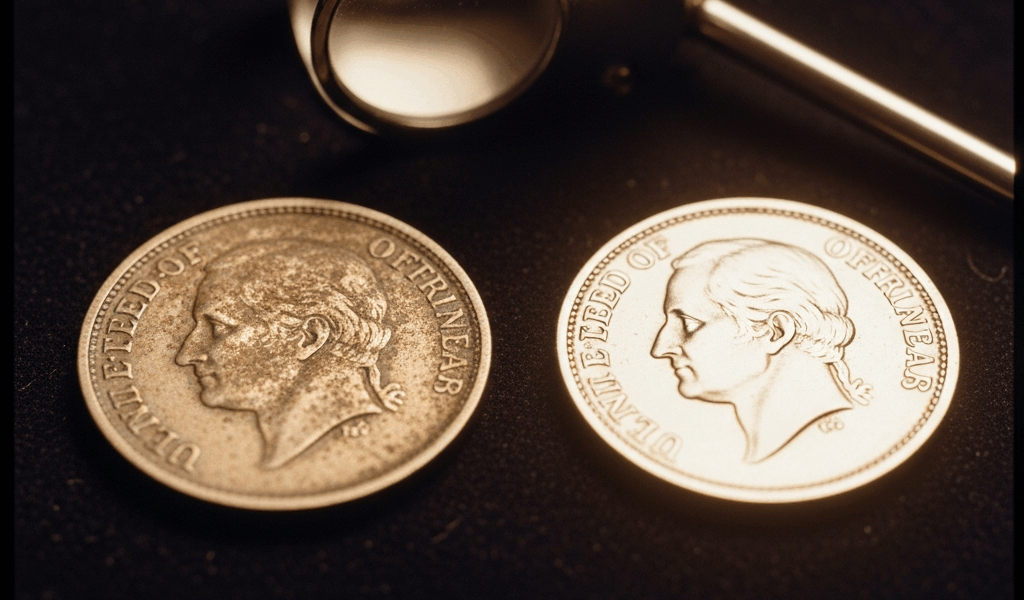
Cleaned coins have a specific kind of brightness that makes my skin crawl now that I know what to look for. It’s not the natural luster of an uncirculated coin. It’s artificially uniform. Sterile, almost.
When a coin sits in circulation for 50 years or in a collection for 130 years, it develops patina—a thin oxidation layer that creates color variation, toning, and what collectors call “original luster.” Real original luster has character. It catches light unevenly. High points might shine differently than fields. There’s actual depth to it.
Professional cleaning strips that away and creates what I call “reset shine”—a reflective surface that looks like it belongs on a brand-new coin from the mint, except the coin shows obvious wear, die cracks, or corrosion. That mismatch is your red flag right there.
Inspect under specific lighting. Natural daylight (not direct sun) is best for that initial look. Then pull out a jeweler’s loupe or 10x magnifier and examine the coin under warm incandescent light. Cleaned coins often show uniform, almost mirror-like reflectivity across the entire surface. Uncleaned coins of the same grade? They show variation—dull fields with brighter rims, or vice versa, depending on how the coin was stored and handled over the decades.
Compare side-by-side if you can swing it. I keep reference photos of graded uncleaned examples at similar grades in a folder on my phone. When I’m examining a coin in person, I pull up a known-good example and look at surface reflectivity. The difference becomes obvious within seconds once you’ve trained your eye.
Check for Missing or Inconsistent Toning
Probably should have opened with this section, honestly. Toning inconsistency is the most reliable indicator I’ve found for detecting professional cleaning.
Original toning—the color that develops naturally on silver coins over decades—follows predictable patterns. It concentrates in protected areas first: the recesses of the design, inside letters, below rims, in the fields if the coin was stored horizontally. High points and edges tone more slowly because they’re exposed to more air and handling.
When professional cleaning happens, that natural toning disappears unevenly. Sometimes cleaners attempt to re-tone the coin afterward to disguise the cleaning. When they do this improperly, you get artificial toning that doesn’t match the pattern you’d expect to see. I’ve examined Barber dimes where the obverse showed purple and blue toning consistent with 70+ years of aging, but the reverse was bright as a new penny. That’s a dead giveaway that someone stripped the reverse during cleaning and either couldn’t match the tone or gave up trying.
Morgan dollars are excellent teaching examples for this. On an uncleaned Morgan with original golden toning, you’ll see color concentrated around the rim and in Liberty’s hair, her face, and the eagle’s feathers. The fields might be nearly untoned or show lighter toning. The reverse lettering will have toning inside the recesses. If you see a Morgan with uniform, even toning across both sides, or bright fields with darkened rims only — that’s not natural. That’s either cleaned or heavily artificially retoned.
Look at the coin in natural light and note where toning appears and where it doesn’t. Compare to 5–10 similar coins at major auction house websites. You’ll start recognizing the patterns pretty quick. When a coin deviates significantly from those patterns, cleaning is usually involved.
Look for Hairlines and Microscratches
This requires magnification—10x minimum, 20x ideally. A digital USB microscope ($15–40) or a jeweler’s loupe will do the job.
Professional cleaning almost always leaves microscratches. Even gentler methods using reverse osmosis water and soft brushes create fine hairlines visible under magnification. These aren’t the random, irregular scratches you see from circulation wear. Cleaning scratches run in patterns—directional marks where the brush or polishing tool moved across the coin’s surface.
The best place to look is the field (the flat, open areas of the coin away from the main design). High points—the nose of a portrait, the tips of stars, the eagle’s wings—can also show this damage clearly. Look at the suspected area under magnification at several angles. Tilt and rotate the coin under the loupe. Genuine circulation scratches are random and scattered. Cleaning scratches follow a direction or pattern.
Advanced cleanings can fool you sometimes, I’ll admit. Polishing with very fine compounds (like fine rouge) or dipping in mild chemical solutions can leave minimal visible marks. But they’re almost always there if you look carefully enough. I’ve never examined a professionally cleaned coin under 20x magnification that didn’t show some evidence of manipulation under the surface.
Red Flags That Suggest Professional Cleaning
- Unnaturally bright rims — Rims pick up handling wear and tone easily. A rim that’s mirrorlike on a coin that shows wear in the field is suspicious.
- Dull, flat fields — When fields lack reflectivity while high points shine, that often indicates selective cleaning or artificial retoning.
- Loss of original luster in protected areas — Recesses and protected areas should retain the most original surface character. If they look artificially bright or matte, cleaning occurred.
- Suspended particles in the slab — If the coin is already graded and slabbed, look for dust, debris, or clouding inside the holder. Sometimes this masks cleaning damage.
- The ‘too clean’ feeling — A coin that’s AU-55 but has the surface appearance of MS-62 probably got cleaned. Grade should match surface condition logically.
- Hairline scratches in organized patterns — Random light scratches are normal. Linear patterns suggest tool marks from cleaning.
- Toning that doesn’t match its peers — Compare to 5+ similar coins of the same date, mint, and type. If toning pattern stands out as unusual, investigate further.
If multiple flags appear on the same coin, skip it. Seriously. I made the mistake of rationalizing away two or three warning signs because I loved a particular coin aesthetically. It always cost me. A $180 coin that shows three red flags isn’t a steal—it’s trouble waiting to happen when you try to sell or submit to a grading service.
When in doubt, send the coin to a professional third-party grader like PCGS or NGC before committing significant money. Submission costs $15–35 depending on the service level. That’s insurance against the $100+ mistake of buying a cleaned coin. If you’re already holding a coin you suspect has been cleaned and you’re considering selling, getting it officially graded—and having that cleaning documented on the holder—actually helps. Disclosure beats discovery by a buyer six months later.

Stay in the loop
Get the latest collectors coin corner updates delivered to your inbox.