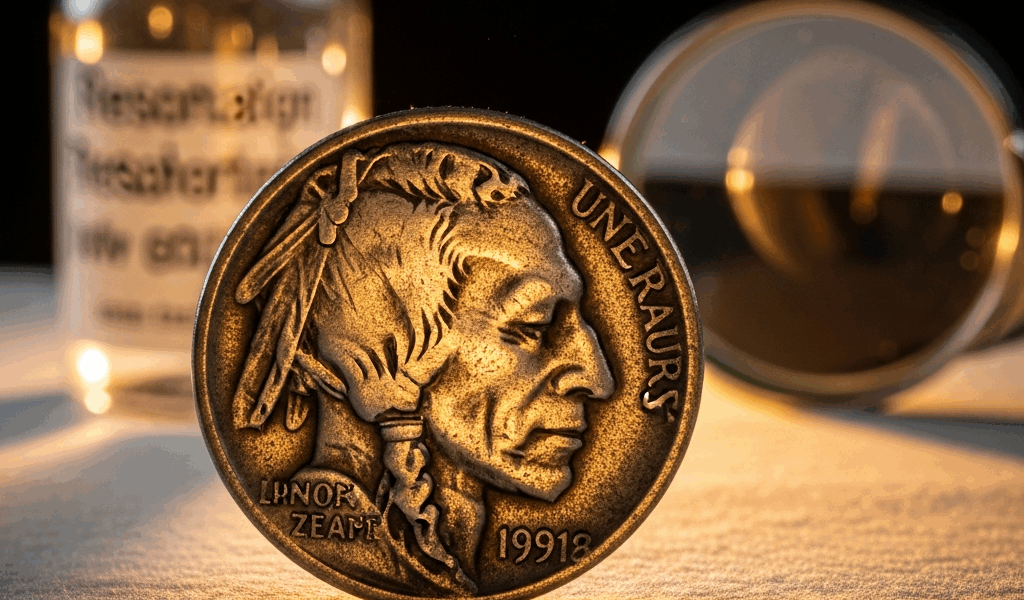
Why Buffalo Nickel Dates Disappear So Easily
Buffalo nickel dates have gotten complicated — with all the misinformation flying around about worn coins, most people don’t realize the problem started before these nickels ever left the mint. James Earle Fraser made a decision in 1913 that haunted every coin in the series: he put the date on the highest relief point of the obverse, right where the Indian’s hair meets the neck. High points wear first. That’s just numismatic physics.
When the U.S. Mint was striking these coins, dies faced relentless pressure — millions of strikes, day after day. The date sat on that raised edge and absorbed the hardest impact every single time. After a few years of pocket-to-pocket circulation, the numerals started softening. Give it ten or twenty years and the date was simply gone.
The original 1913 Type 1 design had the date sitting even higher, which is why Type 2 coins — struck from late 1913 onward — hold up marginally better. But “marginally better” still leaves thousands of dateless Buffalos floating around out there. The mint never corrected this flaw. Not once. Not across the entire run from 1913 to 1938.
What a Dateless Buffalo Nickel Is Actually Worth
Probably should have opened with this section, honestly — because the first thing anyone asks after finding a dateless Buffalo is whether they’re holding something valuable. Short answer: probably not. A completely worn, dateless Buffalo in circulated condition trades for $1 to $3. Sometimes less, depending on overall surface wear and whatever collector demand looks like that particular week.
These are salvage pieces, mostly. The nickel metal content itself comes in around 4 to 5 cents. Collectors pass on them unless something else is going on — unusual die varieties, mint mark anomalies, or wear so extreme it becomes a genuine curiosity.
Here’s where things get interesting, though. If your dateless nickel is hiding a 1916, 1918-D, 1918/7-D, or another recognized key date underneath all that wear, the math changes completely. You could be looking at $50 to $600. A 1916 doubled die — one of the most talked-about Buffalo varieties in the hobby — hammered at $385 in Fine condition at auction last year, and that was with the date still legible. Uncover a key date hiding under decades of wear, and suddenly your $2 coin is something else entirely.
That’s the whole reason the restoration method below exists. It isn’t glamorous. But it works.
How to Read a Worn Date Before Trying Acid
Before you pour anything on a coin, do the detective work first. A ghost date might already be visible — enough to identify the coin without any chemical intervention at all.
Start with angle lighting. Grab a desk lamp or even a basic flashlight and position it at roughly 45 degrees to the obverse. Let the light rake low across the date area. Worn numerals sometimes cast faint shadows that your eye simply cannot catch head-on. That shadow play reveals what’s underneath. I’ve been genuinely surprised how often this step alone does the job.
Get a jeweler’s loupe — 10x magnification is the standard for this kind of work. Real ones run $8 to $15 on any numismatic supply site, or even Amazon. Look at the date area carefully under magnification. You’re hunting for ghost impressions, faint striations, partial numerals. A worn “1” looks different than a worn “9” even when both are nearly flat. A worn “8” leaves telltale remnants that 10x magnification catches almost immediately.
Rotate the coin slowly under the loupe. Try multiple angles. One orientation frequently reveals detail that another completely hides. I’m apparently one of those people who finds this process genuinely absorbing — and that approach works for me while rushing through it never does. Don’t make my mistake of skipping this step.
If angle lighting and magnification give you nothing — no numeral hints, no shadows, no ghost impressions — then acid restoration is worth attempting. If you can already see partial numerals or ghost images, write down what you’ve identified before doing anything else. That protects you from accidentally erasing evidence you’ve already found.
How to Use Ferric Chloride to Restore the Date
Ferric chloride is an industrial etchant. It dissolves corrosion and verdigris without destroying the underlying metal. You want it in solution form — around 40% concentration. Brands like Muromac sell it, and generic laboratory suppliers carry it online for $12 to $20 per bottle. That one bottle will last you a long time.
Materials:
- Ferric chloride solution (40% concentration)
- Small glass or ceramic container — never metal
- Nitrile gloves and eye protection
- Cotton swabs or soft brass brush
- Baking soda and distilled water for neutralizing
- Paper towels
The whole process takes about fifteen minutes.
Pour a small amount of ferric chloride into your glass container — just enough to reach the date area when you dip the coin’s edge. Glove up before you touch anything. Dip a cotton swab into the solution and apply it directly to the worn date region. You’ll see oxidation begin dissolving almost immediately. The solution darkens as it works. That’s completely normal.
Let it sit for 2 to 3 minutes. Watch it the entire time. Don’t walk away — the acid moves fast, and over-etching blurs the very numerals you’re trying to reveal. Two minutes is usually plenty for a first application.
After 2 minutes, rinse the coin under cool running water while lightly brushing the date with a soft brass brush. Just enough pressure to loosen freed material — nothing aggressive. Dry it completely with a paper towel.
Now neutralize the acid. Mix a small amount of baking soda with distilled water to form a loose paste. Coat the date area, let it sit for 30 seconds, then rinse again and dry completely. This stops the ferric chloride from continuing to work invisibly beneath the surface — a step people skip, and shouldn’t.
Check the date under your loupe. Most coins reveal legible numerals after a single application. Some need a second dip, but rarely more than that. Each application technically lowers the coin’s grade, so restraint matters here.
What to Do After You Find the Date
The moment numerals appear — stop etching. Completely. Put the swab down.
If you’ve just uncovered a 1916, 1918-D, or any other recognized key date, set the coin somewhere safe and don’t touch it again. Don’t clean it further. Don’t polish it. Overcleaning has destroyed coins worth five figures. Submit it instead to NGC or PCGS with a note disclosing the acid restoration. Graders will attribute it as “Genuine — Details” or “Improperly Cleaned,” which at least preserves the coin’s identity in the census and acknowledges the treatment honestly. It won’t command top-tier money — but a confirmed key date identification gives you roughly 300% more value than a dateless piece sitting in a drawer.
If the date turns out to be common — 1925, 1930, 1935 — you’ve still accomplished something. You now know definitively what you had. Some collectors pick these up as novelties. Others buy them as blanks for jewelry projects. List it on eBay for $2 to $4, which beats keeping it in a jar for another twenty years.
The real value here is just knowing. Most people never bother to look.




Stay in the loop
Get the latest collectors coin corner updates delivered to your inbox.