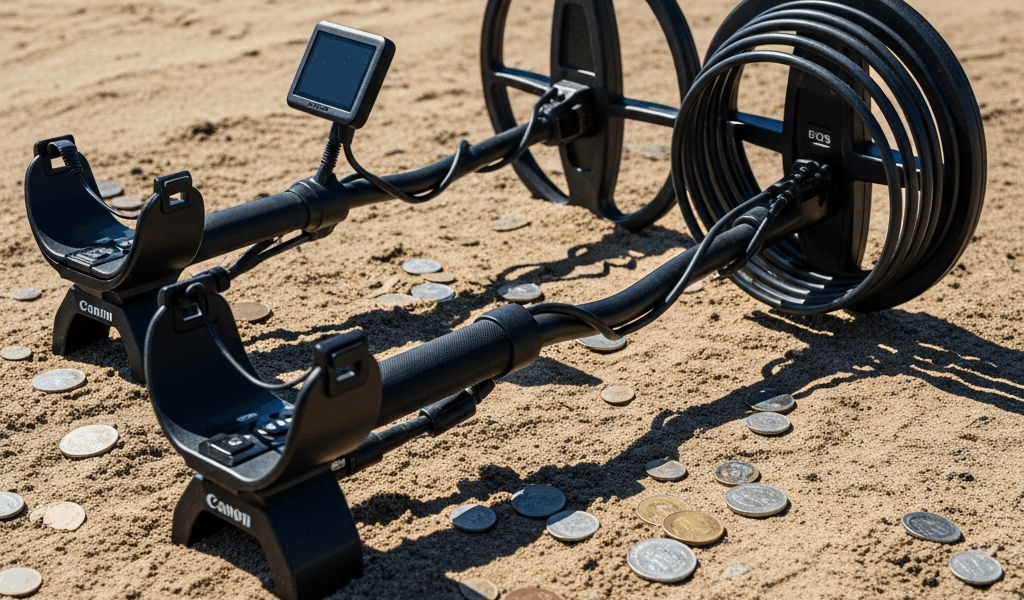
Minelab Vanquish 540 vs 440 for Coin Shooting
Choosing between the Minelab Vanquish 540 and 440 has gotten complicated with all the generic comparison noise flying around. Most articles treat these like all-purpose detectors and hand you a spec sheet when what you actually need is a straight answer. As someone who has hunted with both units across suburban parks, old schoolyard sites, and iron-heavy Civil War-era homesteads, I learned everything there is to know about where these two machines actually diverge. Today, I will share it all with you.
What You Actually Get for the Extra Money
The Vanquish 440 retails around $299. The 540 runs closer to $449. That $150 gap buys you four specific things: adjustable recovery speed, wireless audio via Bluetooth compatible with Minelab’s ML 80 headphones, a backlit display, and the ability to toggle between five individual frequencies — 5, 10, 15, 20, and 40 kHz — on top of Multi-IQ. Both machines run Multi-IQ simultaneously. That part is not exclusive to the 540. Worth saying clearly.
Here’s where it gets interesting for coin hunters specifically. In a clean suburban park with minimal trash, the 440 and 540 perform almost identically on clad. Same coil. Same Multi-IQ processing engine. Same basic discrimination framework. But drop either machine into a park that’s been hunted hard for 40 years — pull tabs sitting six inches deep right next to wheaties — and the 540’s recovery speed control becomes the most valuable thing Minelab put in that box. The 440 gives you zero adjustment there. You’re locked in. That matters more than the wireless headphones ever will.
Coin Discrimination and Target ID Compared
Probably should have opened with this section, honestly. It’s the real question most coin hunters are asking.
Both machines display a target ID on a 1-to-40 scale. Common coins land roughly in these ranges on both units:
- Zinc penny — around 21 to 23
- Copper penny (pre-1982) — around 24 to 26
- Nickel — around 12 to 14
- Dime — around 28 to 30
- Quarter — around 34 to 36
- Silver dollar — around 37 to 39
- Silver dime or rosie — around 27 to 29
Surface targets? The IDs are nearly identical between both machines. The gap opens at depth and in mineralized soil. Bury a silver dime six inches down in clay-heavy ground with moderate iron content and the 440 starts to drift — you’ll watch the ID swing between 24 and 30 on the same coin. The 540 running Multi-IQ holds tighter. Switch it to a single high frequency like 15 or 20 kHz and silver response sharpens noticeably. That doesn’t mean the 440 misses silver. It means you’ll dig more sketchy signals to find it.
On wheaties specifically — Lincoln cents from the 1910s through the 1950s — both machines read them clearly in clean ground. The difference is separation. A wheatie sitting eight inches down next to a rusted iron square nail is where the 440 starts making life genuinely hard. The nail bleeds into the signal and drags the ID down toward the iron range. The 540 with recovery speed pushed up handles that separation better. Not perfectly. But better.
Depth and Recovery Speed on Real Coin Targets
Both machines will find clad quarters at five to six inches without drama. Silver at seven to nine inches is where the platform hits its limits regardless of which model you’re running — these are entry-level detectors, not Equinox 800s. Realistic depth on a silver quarter in average soil is about eight inches on either machine. Don’t let anyone tell you the 540 adds two inches of depth over the 440. It doesn’t. Depth is not the story here.
Recovery speed is the story. The 440 runs at a fixed recovery speed — whatever Minelab chose as a middle-ground setting. Functional for most conditions. Optimal for none in particular. The 540 lets you dial it from 1 to 5. Running at 4 or 5 in a high-trash site means the machine recovers from one target signal faster before it processes the next one. A dime sitting three inches from a pull tab has a real chance of being heard as a dime instead of a smeared, unreadable signal you’d walk right past.
I learned this hunting an old fairground site with the 440. Signal after signal came in as a soft, wide 28 to 31 — I eventually wrote the whole area off as junk. Brought the 540 back to that same ground two weeks later, ran recovery speed at 4, dug eight of those signals, and pulled four silver dimes and two wheat pennies. Same dirt. Different tool. Don’t make my mistake.
Which Ground Conditions Favor Each Machine
Dry, low-mineral parkland turf is the 440’s best environment. Hunting maintained suburban parks, school grounds, or baseball fields with neutral soil and no significant iron content? The 440 performs at near-parity with the 540. Ground balance on both machines is automatic — in benign soil, that automation is sufficient.
Wet sand and salt beaches are a different problem entirely. The 440 struggles with wet salt ground because its fixed operating mode can’t adapt the way the 540 can. Switching the 540 to 5 kHz on wet salt flats dramatically cuts false signals. The 440 chatters in those conditions in a way that makes productive hunting genuinely exhausting.
Heavily mineralized ground — red clay in the Southeast, iron-rich soil in the Midwest, volcanic soil out West — punishes the 440 harder. Here’s the specific problem: mineralized ground creates target ID instability on the 440 that looks exactly like a coin signal. You’ll see repeatable 28s that turn out to be nothing. Not every time. Enough times. I’m apparently sensitive to this particular frustration and the 540 works for me while the 440 never quite settled my nerves on that front. The 540 running Multi-IQ processes across multiple frequencies simultaneously and produces tighter ID clustering on real targets — those phantom signals become easier to dismiss with confidence.
Ask yourself one thing: is your local hunting ground flat and manicured, or old, iron-littered, and variable? That question alone answers most of the 440 vs 540 debate.
So Which One Should Coin Hunters Buy
But what is the right answer here? In essence, it depends on your ground and your goals. But it’s much more than that — it’s about honestly knowing which category of hunter you are right now.
That’s what makes this choice endearing to us coin hunters. There’s no universally correct answer, and anyone who tells you otherwise hasn’t thought about the question seriously. So, without further ado, let’s dive in.
Buy the 440 if you’re new to detecting, primarily hunting low-trash suburban parks with minimal iron contamination, or working within a hard budget. The 440 is not a compromise. It’s a legitimate coin finder — in the right conditions.
Buy the 540 if you’re hunting old sites loaded with iron trash, working mineralized soil, hitting wet or salt-affected ground, or you’ve already picked your local parks clean and need to extract more from difficult targets. The adjustable recovery speed alone justifies the price difference once trashy sites become your regular hunting ground. Add the frequency flexibility and wireless audio and the 540 becomes the obvious call for anyone treating coin shooting as a serious pursuit rather than a casual weekend hobby.
The $150 price gap is real. So is the performance gap — just not in every environment. Know your ground, know your goals, buy accordingly.



Stay in the loop
Get the latest collectors coin corner updates delivered to your inbox.