Why Grading Fees Can Eat Your Profit Fast
Morgan dollar collecting has gotten complicated with all the grading hype flying around. Everyone talks about slabbing coins like it’s free money. It isn’t.
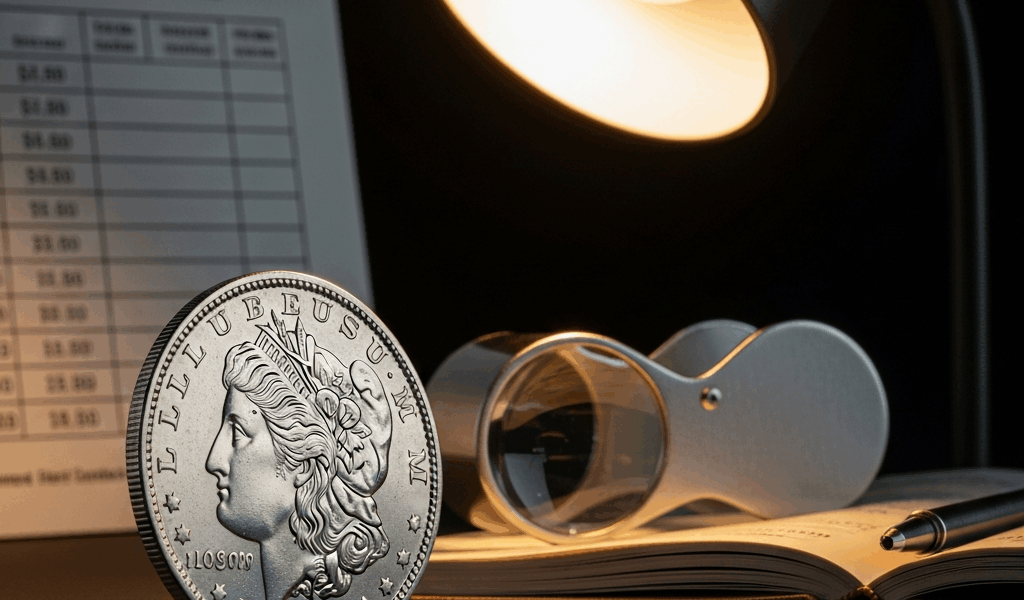
I’m holding a Morgan dollar right now — an 1896-P that looked genuinely promising under my loupe. I almost shipped it to PCGS last spring. Then I sat down and ran the actual numbers.
PCGS Economy service runs $50 per coin. Turnaround is 6–8 weeks. NGC’s comparable tier lands at $40–50. Throw in $3–5 for insured shipping and you’re $55 in the hole before a single grader lays eyes on it. If that Morgan fetches $65 raw and the slab bumps perceived value by maybe $15, you’ve lost money. Forty dollars, gone. That’s not a rounding error — that’s the whole margin.
Nobody in the grading magazines talks about this honestly. They’ll explain what MS64 means all day. They won’t tell you whether submitting a specific coin makes any financial sense whatsoever. That’s what we’re fixing here. Today, I will share it all with you.
The framework is brutally simple: only submit if the upside covers fees plus a comfortable margin. For most raw Morgans sitting in binders right now, that’s a high bar to clear.
Check the Date and Mintmark First
Your Morgan’s date and mintmark are the first filters — and honestly the most important ones. Some coins almost always benefit from grading. Others never do, regardless of condition.
Key and Semi-Key Dates Worth Considering
- 1893-S — The queen of semi-keys. Raw examples sit around $300–500 depending on eye appeal. A solid MS63 can push $800–1,000. Grading pencils out even on lower grades here.
- 1895-O — Another semi-key with real value spread. Raw: $250–400. MS63: $600+. This one justifies submission if you’re being honest with yourself about the grade.
- 1884-S — Common enough raw, genuinely scarce in high grades. Raw sits $100–150. MS65 range: $400–600. Worth submitting if it’s actually nice.
- 1889-CC — Low mintage, real scarcity. Raw $150–300. MS63: $500+. A no-brainer if you’re confident it grades out cleanly.
Common Dates Where Grading Usually Doesn’t Pencil
Then there’s the 1921-P. It’s literally the most common Morgan dollar ever struck. Raw MS63 examples sell for $35–50 online every single day. An NGC slab might push it to $60. The Economy grading fee? Fifty dollars. The math isn’t complicated.
1878–1880 Morgans without an S or O mintmark fall into this same trap. Lovely coins. Terrible economics for grading — unless you’re sitting on a gem specimen that could realistically hit MS65+, which changes the value calculus entirely.
Probably should have opened with this section, honestly. I’m apparently the kind of collector who learned this lesson the hard way, and PCGS made money while I didn’t. I know people who’ve dropped $150 in grading fees on coins that raw-sold for $40–60. Don’t make my mistake. It happens faster than you’d think.
How to Spot a Problem Coin Before You Submit
Frustrated by a mysterious $50 charge that came back as a “details” grade, I started examining every coin with a 10x Bausch & Lomb loupe before touching any submission form. That was 2019. I haven’t gotten a surprise details grade since.
Cleaned by an overzealous collector thirty years ago, a gorgeous 1893-O can look like a legitimate MS64 at first glance. Until you tilt it under a strong light. Then you see hairlines running across the cheek — parallel scratches, not scattered bag marks. Game over.
Hairlines, cleaning, whizzing, and environmental damage are all deal-killers. They trigger a “details” designation, which almost always means raw value exceeds slabbed value. You’ve paid $50 to make the coin worth less on paper.
What to Check With a 10X Loupe
- Cheek and forehead area — The most reflective surfaces catch hairlines immediately. Angle a bright incandescent light and tilt the coin slowly. Cleaned examples show parallel scratches, not the random scatter of genuine bag marks.
- Obverse fields — Look for a hazy sheen or uneven reflectivity across the flat areas. Cleaned Morgans lose their original luster pattern entirely.
- Hair detail above Liberty’s ear — Worn? Fuzzy where it shouldn’t be? That’s rarely honest wear — it’s usually cleaning or environmental damage.
- Eagle breast feathers on reverse — Should show distinct, crisp striation. Any softness here signals problems worth taking seriously.
Wispy hairlines crossing the cheek under angled light — stop there. Dull, washed-out appearance where luster should be — stop there too. Submit it anyway and you’ll get a details grade. You won’t get that $50 back.
Environmental damage is equally fatal. Corrosion, spotting, oxidation — a Morgan with even a small green spot or a cloudy obverse might technically grade MS60, but only with a modifier attached. The value won’t justify the fees.
Estimating the Raw Grade Yourself
As someone who’s submitted over forty Morgans across three years, I learned everything there is to know about pre-submission grading the expensive way. Today, I will share it all with you.
You don’t need professional grader credentials. You need a loupe, a decent light source, and enough honesty to override your own optimism.
For Morgan dollars specifically, these high-visibility areas tell the story:
- Cheek definition — MS65+ shows virtually no disturbance. MS64 shows light wear. MS63 shows obvious wear but retains luster underneath.
- Hair strands above the ear — Distinct and fully separated in MS65. Slightly merged in MS64. Noticeably blended together in MS63.
- Eagle breast feathers — Sharp and separated in MS65. Slight softening in MS64. Visible wear in MS63.
- Field reflectivity — Near-mirror fields in MS65. Mostly reflective with minor disturbance in MS64. Mixed, inconsistent reflectivity in MS63.
Here’s what the numbers actually say: most Morgans in personal collections grade MS63 or lower raw. MS63 on a common date like 1921-P is worth $30–50 raw, maybe $60–80 slabbed. The fee doesn’t pay. Not even close.
MS64 starts to make sense. MS65 almost always does — provided the coin is a key or semi-key date with genuine scarcity backing it up.
If you’re staring at a coin and genuinely unsure whether it’s a 63 or 64, it’s a 63. That’s not cynicism. That’s the observable difference between a coin with light wear and one that barely shows any wear under careful angled light. Most collectors — myself included for a long time — can’t make that call with real confidence.
When Submitting Actually Makes Sense
But what is a good submission candidate? In essence, it’s a coin where the graded value minus fees leaves real money on the table. But it’s much more than that — the coin has to clear several filters simultaneously before the economics work.
Run through this checklist before touching the submission form:
- Is it a key or semi-key date? Open your Red Book. If the coin isn’t listed with notably lower mintage than the 1921-P, stop here. Common dates are financial traps dressed up as investment opportunities.
- Does it estimate MS64 or higher? Be honest. Use the loupe under strong light. If your gut says 63, it’s 63. Let it sit raw or fold it into a type set.
- Is there any sign of cleaning, damage, or environmental issues? One hairline across the cheek. One spot. One patch of dullness. Any of these is a deal-breaker — skip the submission entirely.
- Is the raw value high enough to justify the fee? Work backwards. PCGS Economy costs $50. If grading realistically adds $100+ to the coin’s value, submit. If it adds $15, that’s a charity donation to PCGS’s operating budget.
One caveat worth mentioning — if you’re sitting on coins in older holders, original PCGS or NGC slabs from the mid-1990s, a crossover submission to current holders can justify resubmission on its own. Older slabs take a market premium hit. That’s a different situation entirely. That’s recapturing value you already own.
For raw coins? The rule is tight. Key date, estimated MS64 or better, zero red flags anywhere on the surface, raw value already sitting above $150. Those are your submitters. Everything else stays raw — or gets kept because you genuinely love the coin, which is also a completely valid reason to collect.

Stay in the loop
Get the latest collectors coin corner updates delivered to your inbox.