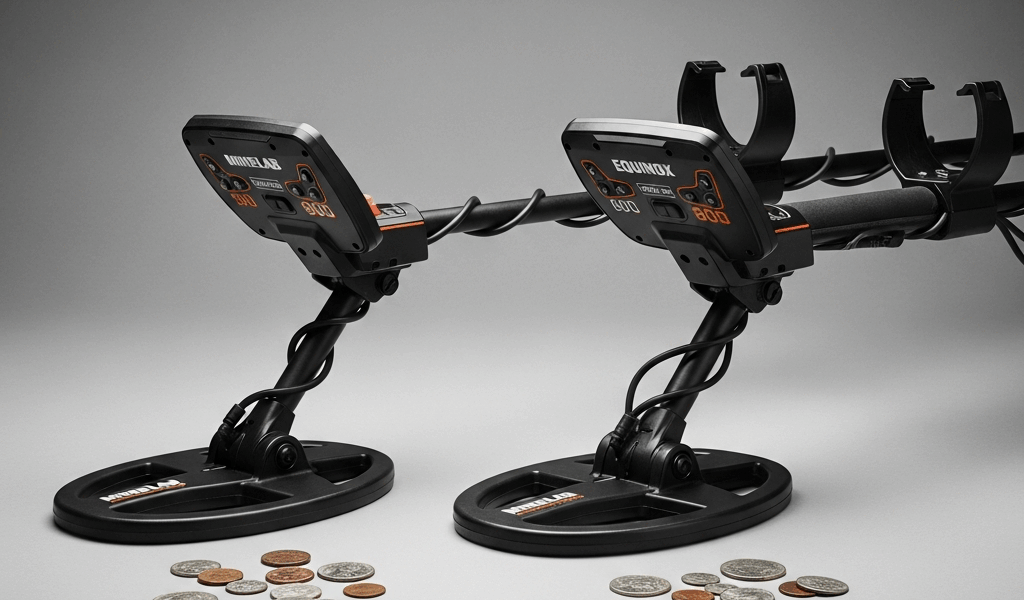
Minelab Equinox 900 vs 800 — Is the Upgrade Worth It for Coin Hunters?
The Minelab Equinox 900 vs 800 debate has gotten complicated with all the forum noise flying around — half of it from people who’ve never swung either machine for more than a weekend. As someone who hunted colonial cellar holes and trashy schoolyard sites across the northeast for years, I learned everything there is to know about what separates these two detectors. My 800 has north of 400 hours on it. I picked up a 900 about eight months ago specifically to run them on the same ground, sometimes the same afternoon. What follows is what I actually found — not the spec sheet, not Minelab’s press release, not forum speculation from guys who handled one at a dealer for ten minutes.
What Changed From the 800 to the 900
The headline numbers are worth knowing before we get into field reality. The 900 runs a 119-segment target ID scale versus the 800’s 50-segment scale. Waterproof depth jumped from 10 feet to 16 feet. The shaft is carbon fiber on the 900 compared to the 800’s plastic composite. Minelab also added a 4 kHz single frequency to the 900’s lineup — so now you’ve got 4, 5, 10, 15, 20, and 40 kHz alongside Multi-IQ.
Surprised by how short that list is, honestly. For a machine retailing around $1,099 USD versus an 800 that’s drifted down to $649–$699 used, you’d expect more. The 4 kHz addition is interesting in theory — lower frequencies have traditionally performed better on large silver and copper coins — but in practical coin hunting sessions I never found myself reaching for 4 kHz as a go-to. Multi-IQ was still doing better work on mixed colonial and clad hunts than any single frequency mode.
The carbon fiber shaft is legitimately nice. Stiffer, better balanced with the 11-inch DD coil attached, and a full six-hour session causes noticeably less arm fatigue than the 800 setup. That’s not nothing. But it’s also not a reason to spend $400 more on a machine.
The 16-foot waterproof rating matters if you wade deep or beach hunt in surf. For land coin hunting — which is what I do 90% of the time — both machines handle rain, creek crossings, and river beach detecting without complaint. Real spec difference. Irrelevant to most park and field hunters.
The 119-Segment ID Scale — What It Actually Means
But what is a 119-segment ID scale, really? In essence, it’s a finer-resolution way of expressing target conductivity. But it’s much more than that — or at least, it can be.
Here’s the honest version. In clean soil with low trash density, the finer ID resolution on the 900 gives you a tighter, more stable number on coins you’ve already dug a hundred times. A copper cent in clean ground that might swing 26–28 on the 800 will read something like 116–118 on the 900 scale with less numerical bounce. That consistency is satisfying. Builds confidence, especially after a long afternoon of marginal signals.
In heavy trash, the story gets more complicated. I’ll get into that next.
What Coin Hunters Actually Notice
Frustrated by a particularly brutal trashy schoolyard permission that was humbling my 800 — we’re talking a site in use since the 1920s, the top six inches a soup of bottle caps, pull tabs, zinc pennies, and bent iron wire — I started running the 900 side-by-side on the same grid, same week, same sensitivity settings. This is where the differences between the two machines showed up clearly enough to matter.
Iron Separation in High-Trash Sites
The 900 separates iron from non-ferrous targets more crisply in dense trash. This isn’t a night-and-day transformation — the 800 is already excellent here — but the improvement is real. On the 900 I was recovering targets sitting within two or three inches of iron nails and getting cleaner audio breaks than I’d get on the 800. A couple of wheat cents came out of that schoolyard during 900 sessions that I’d walked right past in 800 sessions. That’s not confirmation bias. I gridded the same section in the same week with stakes and string.
The iron audio tone on the 900 is also more distinct. The 800’s iron grunt is perfectly usable, but the 900 gives you a sharper separation between the grunt and the non-ferrous signal — and in a field full of quiet trash that demands concentration, that matters a lot after hour four.
Target ID Stability — Real Differences vs the Spec Sheet
Target ID stability is genuinely improved on the 900. Even running both machines at identical sensitivity settings on identical targets, the 900 locked on faster and held its ID number with less bounce. A dime at six inches would swing 2–3 numbers on the 800. Same dime, same depth — 1–2 numbers on the 900.
Does this change what you dig? Marginally. Experienced Equinox users have already learned to read their 800’s bounce patterns. The 900 makes the process slightly less interpretive — more confirmatory than analytical. New users benefit more from this improvement than veterans who’ve internalized the 800’s behavior over hundreds of hours.
Don’t make my mistake. Early in the 900 comparison, I assumed the finer ID scale meant I should set up tighter discrimination notches. The 900’s iron falsing in heavy trash meant tightening those upper-end notches actually caused me to blank good targets reading inconsistently due to adjacent iron. Keep your discrimination approach similar to what you ran on the 800 — let the finer ID inform your dig/no-dig call rather than automating it through notch settings.
The 4 kHz Frequency in Practice
I ran the 900 in 4 kHz on a deep silver permission — a colonial-era farm field in upstate New York where I’ve pulled 8-reale silver coins and large copper coins in the past. Depth performance in 4 kHz single frequency was comparable to 5 kHz. It didn’t unlock additional depth or sensitivity on large silver over what Multi-IQ was already doing. Your experience might vary by soil mineralization, but I wouldn’t buy a 900 for the 4 kHz frequency alone.
What Did Not Change
Probably should have opened with this section, honestly, because it frames the entire upgrade question. The core technology in both machines is identical. Multi-IQ — the simultaneous multi-frequency processing that made the Equinox platform dominant when it launched in 2018 — runs the same in both. Ground balancing system is the same. Coil architecture is the same.
Coil Compatibility
Every coil made for the Equinox 800 works on the 900. The Minelab 6-inch DD, the 15-inch DD, third-party options from Coiltek and Nel — they all cross-fit without adapters. This is a significant point that gets buried under upgrade hype. A lot of the depth and target separation improvements coin hunters attribute to “upgrading their machine” are actually coming from running a different coil — not a different detector body. If you want better performance in thick iron on your 800, a 6-inch coil will do more for you than a 900 body at half the price difference.
Menu System and Controls
The 900 updated the display interface and the menu navigation feels marginally cleaner. But if you have 100+ hours on an 800, you’ll sit down with a 900 and be fully functional within twenty minutes. Nothing was moved far enough to require relearning. The tones, sensitivity adjustment, ground balance tracking, recovery speed — all operates on the same logic. The 900 adds a couple of additional display customization options that I haven’t found essential.
Detection Depth
This is the big one for coin hunters, and I want to be direct: the 900 does not detect meaningfully deeper than the 800. In air tests, the numbers are essentially the same. In the ground, differences I measured across dozens of controlled test bed recoveries fell within the margin of soil variability. If someone is selling you on the 900 as a depth upgrade, that’s not accurate. An 800 with a quality large coil will outrun a stock 900 for depth every time.
Should You Upgrade or Buy a Used 800
Here’s the verdict after eight months of running both machines. It’s conditional — and the conditions matter enough to be specific rather than vague.
Upgrade to the 900 If
- You hunt predominantly in high-trash sites — dense iron, heavy pull tab fields, old schoolyards, fairgrounds. The improved iron separation and ID stability are noticeable and genuinely useful in these conditions.
- You beach hunt or wade regularly in water deeper than ten feet. The upgraded waterproofing is a real spec difference that matters for that use case.
- You’re buying new and comparing new prices directly. Right now the 900 retails around $1,099 and the 800 around $899 new. For a $200 difference on new machines, the 900’s improvements start making more sense.
- You want the carbon fiber shaft and the build quality improvement. It’s a real quality-of-life upgrade for long sessions — underrated, honestly.
Stick With the 800 or Buy a Used 800 If
- You hunt primarily clean sites — low-trash parks, farm fields, forest sites with minimal modern trash. The 800 will match the 900’s performance so closely you won’t notice a difference in a day’s hunting.
- You’re on a budget comparing a used 800 at $550–$650 against a new 900 at $1,099. Take that $400–$500 difference and put it toward a second coil, a quality pinpointer like the Minelab Pro-Find 35, and a handful of good permissions. You’ll find more coins that way.
- You already own an 800 in good condition. The upgrade isn’t worth the cost unless you’re hunting trashy sites regularly and can actually feel the machine holding you back.
The Used Market Angle
Worth mentioning — the 900’s release drove down used 800 prices considerably. Clean used Equinox 800 units turn up on the detecting forums regularly — Friendly Metal Detecting Forums and Dankowski Detectors’ classifieds are the ones I check — for $550–$650 with under 100 hours on them. For a first Equinox, that’s an exceptional value. The machine you’re getting is still one of the two or three best coin hunting detectors under $1,000 on the market. The 900 didn’t make it obsolete. It improved on it at the margins.
If I were starting fresh today with no machine and a $700 budget, I’d buy a clean used 800 without hesitation. If I had $1,100 to spend new and was hunting primarily trashy urban permissions and park sites, I’d spend the extra $200 over an 800 and get the 900. That’s what makes this platform endearing to us coin hunters — you can enter it used and still be running a genuinely competitive machine. The 900 is better. It’s not dramatically better. And in coin hunting, the operator, the permission, the coil selection, and the recovery speed settings are doing more work than the generation gap between these two models.
Both machines run the same Multi-IQ platform that changed what sub-$1,000 detecting looked like when it launched. The 900 refines that platform in ways that are genuine but incremental. Know your hunting conditions, know your budget, and make the call from there — not from forum hype.




Stay in the loop
Get the latest collectors coin corner updates delivered to your inbox.