Why Silver Coins Tone and What Causes It
Silver coin storage has gotten complicated with all the misinformation flying around. As someone who lost a small fortune in coin value through sheer ignorance, I learned everything there is to know about toning, reactive materials, and what actually keeps silver safe. Today, I will share it all with you.
Ten years ago, I stuffed a handful of Morgan dollars into soft PVC flips — the cheap, flexible kind you find at every coin show — and shoved them into a desk drawer. Six months, I told myself. It was fourteen months before I remembered them. The coins came out with thick, blotchy brown and black toning baked into the surface. Non-negotiable damage. That was 2014, and I’ve been obsessive about storage ever since.
So what actually causes toning? In essence, it’s silver reacting with sulfur compounds in the surrounding air. But it’s much more than that. PVC flips off-gas chlorine and other reactive chemicals — slowly, invisibly, constantly. Humidity accelerates the whole process. Even paper envelopes with acid-based adhesives can introduce sulfur compounds directly onto a coin surface. A rubber band around a stack of coins can tone them in weeks. Weeks.
The villain isn’t always where you’d expect. Wood shelving releases organic acids. Cardboard traps moisture and introduces sulfur. Humid basements create the perfect conditions for accelerated toning. Temperature swings make the coin surface expand and contract, letting reactive particles push deeper into the metal. It’s not mysterious — it’s basic chemistry. And that means you can actually control it.
The Worst Storage Mistakes Collectors Make
Most people don’t set out to ruin their coins. They just don’t know what’s dangerous. Don’t make my mistake.
- Soft PVC flips — These are everywhere and actively destructive. The plasticizer chemicals leach onto coin surfaces over months or years, leaving greenish or blue-black toning behind. Hard plastic is a completely different animal; soft PVC is the problem child.
- Paper envelopes with adhesive seals — The glue contains sulfur compounds. Archival paper exists for a reason. Standard paper doesn’t cut it, full stop.
- Rubber bands and string — Rubber off-gases sulfur. A single rubber band around five coins can tone them in weeks, even inside a cool closet with nothing else wrong.
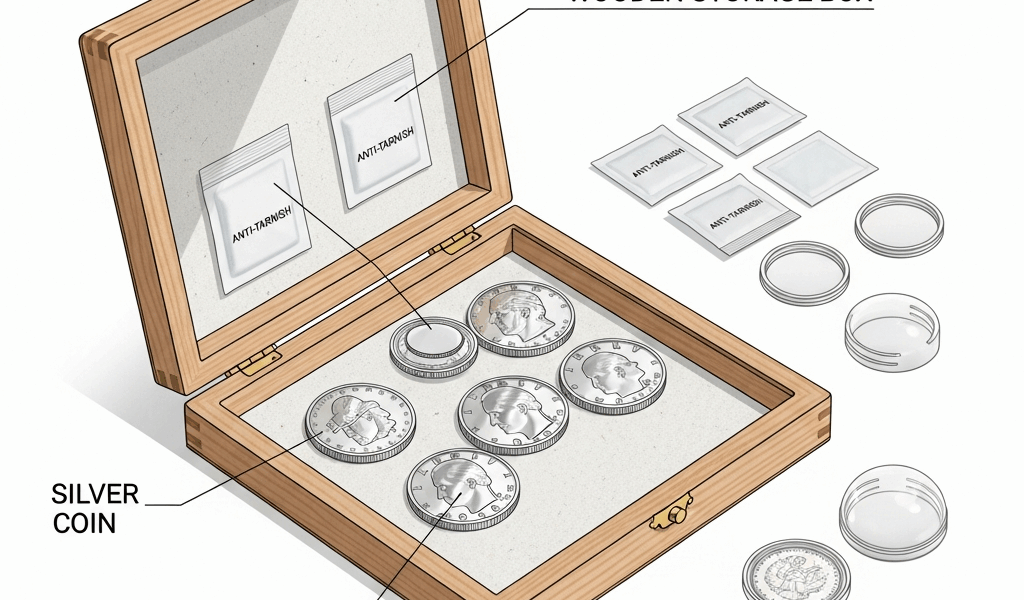
- Wood storage boxes or wooden shelves — Looks great, actively harmful. Wood releases acids and tannins that attack silver over time.
- High humidity basements — Basements are cheap storage, which is why everyone uses them, which is why everyone ruins coins. Sixty to seventy percent relative humidity is a toning accelerator. Silver needs 35–45% RH.
- Direct sunlight near windows — Light itself isn’t the villain here. Heat from sunlight raises local humidity and drives chemical reactions faster than you’d expect.
Best Materials for Storing Silver Coins Safely
Probably should have opened with this section, honestly. The material you choose determines everything else, and none of this has to cost a fortune.
Mylar flips might be the best entry point, as everyday coin storage requires something inert and affordable. That is because Mylar off-gases nothing — no PVC, no reactive chemicals, no surprises. A box of 100 runs about $8–12 and works fine for coins you’re not planning to seal away for decades. Simple upgrade, zero damage risk.
Hard plastic capsules made from polystyrene or acrylic offer better long-term protection. Air-Tite makes capsules in every size — penny through silver dollar — for roughly $0.50–$2 per piece depending on diameter. I’m apparently an Air-Tite loyalist at this point, and they work for me while off-brand capsules never quite seal right. These are inert, clear, and stackable. I keep all my bullion rounds and lower-grade numismatic pieces in them.
Intercept Shield products — flips and envelopes embedded with a reactive material that absorbs sulfur from the surrounding air — are genuinely effective for serious collectors. They cost more, around $1–3 per flip. But what is Intercept Shield, really? In essence, it’s a passive anti-tarnish system built into the holder itself. But it’s much more than that — it’s actively scrubbing the microenvironment around your coin rather than just isolating it. For genuinely valuable pieces, this is where the money makes sense.
Third-party grading slabs from NGC or PCGS are the gold standard. A slabbed coin sits sealed in an inert, tamper-evident holder and carries a professional grade. If your silver coin is worth more than $100–200, professional grading eliminates guesswork entirely. NGC slabs run $25–75 per coin depending on declared value and turnaround tier. That’s what makes slabbing endearing to us collectors — you’re not just protecting the coin, you’re documenting it.
How to Set Up a Low-Toning Storage Environment
Safe materials mean nothing in a fluctuating attic or a humid garage. So, without further ado, let’s dive in.
Control humidity first. Buy a cheap hygrometer — around $10–20 on Amazon — and check your actual storage space before assuming it’s fine. You want 35–45% relative humidity. Running higher? Add silica gel packets. A 500-gram packet costs $3–5 and handles moisture in a sealed container or small drawer. Recharge them every 3–6 months by baking at 250°F for about two hours until they’re bone dry and ready to go again.
Keep temperature stable. Climate-controlled closets beat basements or attics — full stop. Your coins don’t need to be cold. They need consistency. Swings between 50°F and 80°F repeatedly will open the coin surface to toning over time. A steady 65–70°F indoors is ideal and easy to maintain in any lived-in room.
Block light exposure. Store coins in opaque containers or drawers, not on open shelves near windows. This prevents heat buildup and keeps the storage environment stable between visits.
Separate coins from problem materials. While you won’t need a hermetically sealed lab, you will need a handful of plastic bins and some discipline. Don’t store coins on wooden shelves or inside cardboard boxes, even if the coins themselves are in inert holders. The reactive materials don’t have to touch the coin directly to cause harm — they just have to share the same air.
Add anti-tarnish strips for long-term drawers. If you’re storing coins in a sealed drawer or cabinet for years at a stretch, toss in a single anti-tarnish strip — around $1–2 each. One strip per 50 cubic inches absorbs ambient sulfur compounds from the closed space. Cheap insurance.
I use a combination approach now: Mylar flips inside a sealed plastic storage drawer, silica gel packets tucked into the corners, sitting in a climate-controlled closet. Total investment: maybe $30 for the drawer, $15 for silica gel, $10 for a box of Mylar. Five years in, zero toning on anything.
When Toning Is Okay and When It Hurts Value
Here’s the nuance that separates collectors from novices: not all toning destroys value. Some toning actually adds it. That was a revelation for me early on.
Natural toning on older coins — especially Morgan dollars and Peace dollars from the 1880s through the 1920s — is often desirable. A Morgan with deep blue and gold toning can genuinely be worth more than a dull, untoned example. Numismatists draw a firm line between “problem toning” (blotchy, uneven, black spotting) and “original toning” (even, progressive color that developed naturally over decades in original mint bags). That distinction is everything.
The toning you’re trying to prevent is the harmful kind — storage toning caused by PVC off-gassing, humidity spikes, or direct contact with reactive materials. That’s the black, spotty, uneven stuff that reads immediately as “this was stored wrong.” A coin graded MS-65 can slide to MS-62 because of problem toning alone. On a valuable Morgan, that’s a $500 swing or more.
First, you should identify what type of toning your coins already have — at least if you want to know whether you’re protecting value or chasing your tail trying to reverse something you shouldn’t touch. If you own old silver dollars with attractive original toning, your job is simply to protect that toning going forward. If you own bullion or modern proof coins, you want them toning-free — that’s the baseline expectation for those pieces.
The storage methods here work for both situations. You’re preventing damage, not erasing history.


Stay in the loop
Get the latest collectors coin corner updates delivered to your inbox.