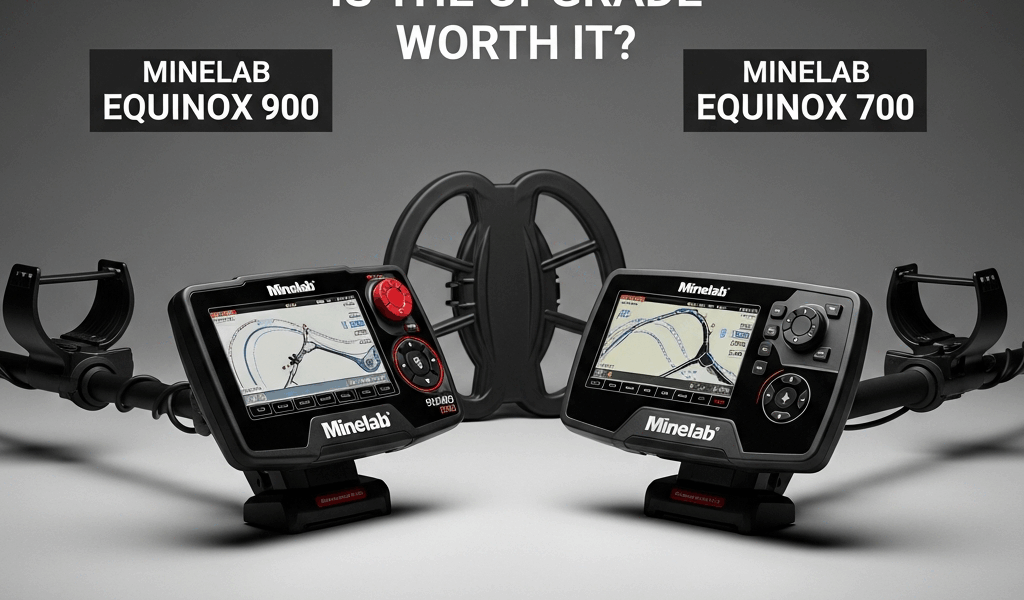
Minelab Equinox 900 vs Equinox 700 — Is the Upgrade Worth It?
This article includes affiliate links. We may earn a commission at no extra cost to you.
The Minelab Equinox 900 vs 700 debate has gotten complicated with all the forum noise flying around since Minelab dropped the 900 series in late 2022. As someone who owns both machines and has run them back-to-back across parks, farm fields, and saltwater beaches in New England, I learned everything there is to know about what actually separates these two detectors — and what doesn’t. I picked up the 700 first, ran it for about eighteen months. Then last spring a club member sold his 900 for $749 and I grabbed it. Not because I felt like I was missing out. I was just genuinely curious whether Minelab improved something real or handed us a fancier spec sheet over the same internals. After a full season switching between them — sometimes literally on the same site, same afternoon — I have an actual answer.
What the 900 Adds Over the 700
Vague comparisons don’t help anyone decide whether to spend an extra $200. So let’s get specific.
The Equinox 700 runs Multi-IQ simultaneously plus single frequencies of 5, 10, 15, and 20 kHz. The 900 adds 4 kHz and 40 kHz to that lineup. That 40 kHz option is genuinely useful for tiny gold targets — nuggets, thin chains, small earring backs. If you’re coin shooting in city parks, 40 kHz won’t change your life. Beach jewelry hunting? Different story entirely.
But what is the real audio difference between these two machines? In essence, it comes down to latency. But it’s much more than that. The 900 ships with the ML 80 headphones using Bluetooth Low Latency. The 700 has Bluetooth too — standard Bluetooth — and the lag is noticeable enough to throw off your swing-to-dig timing when you’re moving fast. Don’t make my mistake of assuming both models had equivalent wireless performance. They don’t. The ML 80 headphones paired with the 900 feel closer to wired than anything I’ve used without an actual cord.
Here’s what else separates them:
- Ground balance options — The 900 adds ground tracking with adjustable tracking speed, plus a dedicated ground balance “grab” that’s faster to execute mid-hunt. The 700 has auto and manual ground balance but no adjustable tracking speed.
- Horseshoe mode — Both have it, same implementation.
- Target trace — The 900 has a Target Trace feature that gives you a two-dimensional visual plot of a target’s conductivity and ferrous content at the same time. The 700 doesn’t have this.
- Selectable recovery speed range — Both machines go from 1–8, identical range, identical behavior.
- Backlight brightness — The 900 display is brighter and easier to read in direct sunlight. Small thing, genuinely annoying on the 700 when you’re working a park on a clear afternoon in August.
- Extra custom search profiles — The 700 gives you three. The 900 gives you eight.
Frustrated by the 700’s ground balance behavior on a mineralised colonial site in Vermont, I spent a full morning running the 900 on the same ground — same coil, same paths, same spots. The adjustable tracking speed alone made that session less mentally exhausting. Highly mineralised soil punishes a detector with slow tracking. The 900 handles it better. That’s what makes the ground tracking upgrade endearing to us relic hunters.
Detection Depth and Performance
This is the section people actually want. Does the 900 dig deeper?
Mostly no. Not in the scenarios most detectorists face most of the time.
On a standard coin-shooting hunt — compacted park soil, old school grounds, urban fill — I’ve run both detectors back-to-back on the same areas with the same coil, same Multi-IQ mode, same sensitivity settings. The 700 and 900 return virtually identical depth on clad and older silver. Quarters at 8–9 inches, dimes at 7 inches, the occasional deep wheatie at 10 inches with both machines screaming at you to dig. I did not find a single coin in those sessions that one machine hit and the other missed at comparable settings.
Where the 900 starts earning its premium is two specific situations.
First, salt beach hunting. The 900’s faster ground tracking outperforms the 700 in wet sand near the surf line — I’ve tested this specifically at Plum Island in Massachusetts, walking the same stretch with both machines on separate visits. Salt-saturated ground is brutal for any detector. The 900’s handling of that environment is more stable, fewer false signals, tighter target IDs. The 700 is usable on a salt beach, but you’re fighting it. The 900 is composed.
Second, tiny low-conductivity targets. Running 40 kHz, the 900 picks up a thin gold earring or a small hammered coin that the 700 will either ghost entirely or hit inconsistently. Higher frequency means better sensitivity to small, low-conductive objects — that’s physics, not marketing. If your targets are predominantly clad and silver coins in the nickel-to-quarter conductivity range, neither the 40 kHz nor the enhanced ground tracking will measurably improve your find rate.
Probably should have opened with this section, honestly, because the depth question is what most people lead with — and the answer is genuinely simple: equal on standard targets in standard ground, and the 900 wins on salt beaches and tiny gold.
The Target Trace Feature in Practice
I was skeptical of Target Trace when I first saw the demo videos. Looked like a feature designed for a product brochure. Then I used it on a heavily trashed old farm field in central Massachusetts — nails and farm equipment debris everywhere, the kind of site that makes you question your hobbies — and I changed my mind. Seeing the conductivity and ferrous plot simultaneously lets you make faster dig-or-no-dig decisions on borderline targets. It doesn’t replace experience. It accelerates it. A newer detectorist will benefit from this more than a veteran, but veterans will still find it useful in high-trash environments.
The Price Gap
At current retail, the Equinox 700 runs about $649 USD. The 900 retails for $849 USD — a $200 gap, though you can sometimes find the 900 discounted to $799 through authorized dealers like Kellyco during promotional periods.
Here’s how I actually think about the feature delta:
- Low-latency Bluetooth with ML 80 headphones — those headphones retail for around $100 separately if you buy them for the 700. So the real audio upgrade cost is closer to $100, not $200.
- The 40 kHz frequency — worth it for jewelry hunters and gold prospectors, irrelevant for coin-only hunters.
- Adjustable ground tracking — worth it for anyone hunting mineralised sites, beaches, or relic hunting in agricultural fields. Unnecessary for manicured parks with neutral soil.
- Target Trace — legitimately useful, no workaround on the 700.
- Eight profile slots vs three — most detectorists honestly use two or three profiles regularly. Nice-to-have, not a game-changer.
If you hunt only maintained parks and athletic fields for modern coins and the occasional dropped ring, you are paying $200 for features you will never use. That’s the honest math.
If you hunt beaches, old farm fields, wooded colonial sites, or if you’re chasing jewelry with any seriousness — the $200 starts to look reasonable, especially factoring in that you’re not buying a separate set of low-latency headphones down the road.
One thing I learned the hard way: don’t buy the 900 thinking it will fix poor technique. I spent my first six months with the 700 digging trash because I hadn’t developed good swing discipline and was running sensitivity too high. A better detector does not solve that problem. Time in the field solves that problem. If you’re new to detecting, that $200 is better spent on a research book, a soil probe, and a quality pinpointer — the Garrett Pro-Pointer AT works well and runs around $130.
The Verdict
Here’s where I land after running both machines across a full season.
Coin hunting in parks — buy the 700. There is no practical performance difference on standard coin targets in neutral ground. Save your $200. The 700 is an excellent machine that will keep up with the 900 in this exact scenario, target for target, all day long. Anyone telling you otherwise is rationalizing their upgrade purchase.
Beach hunting — buy the 900. Full stop. The ground tracking behavior alone justifies the premium if you spend meaningful time on salt beaches. Add the low-latency headphone setup and you have a noticeably better tool for that environment. The Equinox platform already competes seriously with dedicated beach machines like the Nokta Legend in the same price tier — the 900 represents the stronger version of that argument.
Relic hunting on mineralised sites — buy the 900. Adjustable tracking speed is a real-world advantage in old agricultural fields and high-mineral soil. The Target Trace feature helps on trashy sites. These aren’t theoretical benefits — I’ve used both on the same Vermont farm site and the 900 was less fatiguing, returning cleaner target IDs on deep iron-masked targets.
New detectorist on a budget — buy the 700. Or consider the Equinox 600, which still runs Multi-IQ and will teach you everything you need to know about the platform at a lower entry price. The 900’s advanced features require enough base knowledge to use them well. A beginner running the 900 on auto ground balance with default settings isn’t getting $849 worth of detector — they’re getting a $649 detector with buttons they haven’t learned to push yet.
Both machines are built on the same Multi-IQ platform, share the same coil compatibility, and use the same physical design. The Equinox line as a whole represents genuinely good engineering for the price. The 900 is a better machine. It’s not a dramatically better machine. Know your hunting environment, be honest about your experience level, and make the call from there.
Dragged into my fourth season of detecting by an increasingly full finds tray and an embarrassing collection of wheat pennies, I’d buy the 900 again — but only because beach hunting is where I spend most of my time now. If I were hunting parks exclusively, my 700 would still be my only detector and I wouldn’t feel like I was missing anything worth $200.



Stay in the loop
Get the latest collectors coin corner updates delivered to your inbox.