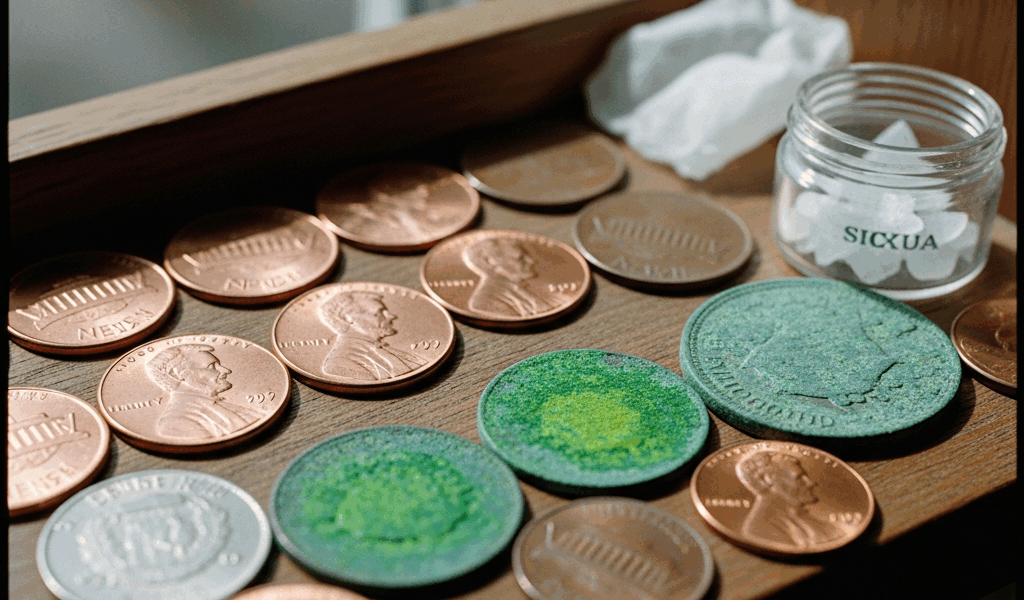
What Is Actually Causing That Green Stuff
Copper coin storage has gotten complicated with all the conflicting advice flying around. So let me cut through it and tell you exactly what you’re looking at — because not every green coin is a crisis, and not knowing the difference will cost you.
But what is verdigris? In essence, it’s active corrosion eating your copper alive. But it’s much more than that — it’s a warning sign that something in your storage setup is chemically attacking the metal right now, this week, while the coin sits in its holder.
Here’s what trips people up. A dark, stable olive or chocolatey-brown patina on an 1880s cent? That’s natural toning. Collectors actually want that. It means the coin spent decades slowly building a protective layer. The stuff you panic about is bright, powdery, almost neon green — sometimes flaking. That’s verdigris. Different animal entirely.
Three things cause it. Moisture. PVC off-gassing from cheap vinyl holders. Acidic materials like sulfur hiding in cardboard. Any single one of those can wreck a coin inside of six months. Probably should have opened with this section, honestly. When I pulled my collection out after a humid Virginia summer in 2015, three coins had active verdigris I’d completely missed for weeks. Dark corner of a safe, sealed tight — felt like a secure setup. It wasn’t.
Moisture is the most common culprit. Copper oxidizes when water vapor sits on its surface. Even 65 percent humidity inside an enclosed plastic box or safe creates enough of a microenvironment to trigger the reaction. Add warmth and it accelerates fast. PVC flips — those clear vinyl 2×2 sleeves — are the second major problem. Cheap vinyl off-gases hydrochloric acid over time, and that acid attacks copper directly. You’ll see bright green crust forming right where the vinyl touched the coin. Then there’s sulfur: cardboard holders from the 1980s and 1990s, sulfur-heavy paper, rubber bands. Sulfur reacts with copper and creates dark, crusty corrosion. Looks a little different from moisture-driven verdigris but causes the same destruction.
How to Tell If the Damage Is Still Spreading
Open your storage box. Look at the green. Bright and powdery? That’s urgency territory — the coin is actively oxidizing right now, pulling copper atoms off the surface and converting them into corrosion. Fine details go first. The tiny lines in hair. The texture of a designer’s initials. A coin grading MS-65 today can slide to AU-50 in six months if active verdigris goes ignored.
Dark olive or mottled brown-green on a coin older than 50 years is almost always stable patina. It won’t spread. It won’t eat more detail. Leave it alone — seriously, do not touch it.
Here’s the test. Get a 10x loupe — a Bausch & Lomb Coddington works fine, runs about $18 on Amazon. Look at the green area. Crusty, lifting, forming in crystal-like patches? Active. Smooth, uniform, bonded tightly to the surface? Stable patina. Texture tells you more than color does. One more tell: active verdigris smells faintly like vinegar or ocean air. That’s acidic volatiles releasing. Stable patina smells like absolutely nothing.
The Storage Mistakes That Cause This Most Often
I’m apparently someone who learned all of this the expensive way, and avoiding vague advice here matters — so I’ll name actual products.
PVC flips. The clear plastic 2×2 sleeves from any coin supply catalog, usually under $5 per hundred — Whitman brand, Guardhouse brand, generic store flips. Even the ones labeled “safe” can off-gas if they’ve sat in heat or aged past two or three years. I tested a batch of three-year-old flips from my desk drawer once and found a faint but distinct chemical smell. The proof coins inside them had already been exposed. Don’t make my mistake.
Cardboard 2×2 holders are next. Some premium brands have genuinely minimized sulfur content. Others — especially vintage holders from the 1980s — carry enough sulfur to generate dark crusty verdigris within a year. Smell test: rotten eggs means sulfur. Simple as that.
Rubber bands. Never. I’ve seen coins stored in a jewelry box with a rubber band wrapped around them develop a dark green stripe running exactly where the band contacted the copper. The sulfur in rubber reacts with the metal. You’re running a slow chemical reaction every single day that band touches your coin.
Humid storage without desiccant. A basement safe hitting 70 percent humidity in August. A garage where temperatures swing from 50 to 85 degrees Fahrenheit between January and July. A hall closet in coastal Florida. I’m apparently a humid-climate person and silica gel works for me while any sealed-but-empty container never does. Even “airtight” brand-name containers fail if moisture was trapped inside the day you sealed them. I inherited a collection stored in a well-known airtight case — no desiccant inside, tight seal, five years of storage. Seven coins had bright active verdigris when I opened it.
What to Do With a Coin That Already Has Verdigris
Frustrated by finding active corrosion on a coin I’d owned for years, I started researching conservation seriously. What I learned: the panic-clean instinct will destroy the coin faster than the verdigris will.
Step one is removing the coin from its current holder immediately. Whatever caused the verdigris is still active. Move the coin to a clean archival paper envelope — not notebook paper, not a plastic bag — and separate it physically from the rest of your collection. Cross-contamination through off-gassing is real.
Step two: do not rub, wipe, scrub, or attempt any mechanical cleaning. A coin with verdigris but intact surface detail can still grade. A coin you scraped at with a cloth or Q-tip grades as “cleaned” and loses roughly 50 percent of its value. That’s a permanent designation. The scratch marks don’t heal.
Step three: figure out if professional conservation makes sense. Rare date? Proof? Early American copper? Send it to NCS — NGC Conservation Services. Cost runs $20 to $50 per coin depending on severity. They use chemical stabilization processes, no mechanical removal. That’s what makes NCS worthwhile to us collectors who’ve already lost coins to bad cleaning calls.
Common circulated cent? Common Morgan date with heavy corrosion? Honestly, the coin is probably already past the point where conservation pencils out. The lesson cost you a few dollars. Move forward and store the next one correctly.
How to Store Copper Coins So This Does Not Happen Again
So, without further ado, let’s dive in — here’s what actually works, with specific products and prices.
Flips: Mylar — 2-mil thickness, archival grade. Not PVC, not vinyl, Mylar. It’s chemically inert and off-gases nothing. Expect to pay $8 to $12 per hundred. E. Gerber makes a reliable version. Worth every cent for copper storage.
2×2 holders: Archival-quality cardboard only, with sulfur-free paper. Lighthouse brand or Intercept Shield brand. They run 20 to 40 cents per holder. While you won’t need industrial archival equipment, you will need a handful of these over cheap generic holders — the cost difference is negligible and the protection lasts decades.
Storage containers: Glass jars with metal lids work well. Tight-sealing plastic containers work too — but only with desiccant inside. An empty sealed container just traps whatever air humidity was present when you closed it.
Desiccant: Silica gel packs. One pack per quart of storage space. Replace every 12 months. A ten-pack runs about $3 on Amazon. This might be the best single investment in the list, as copper storage requires consistent humidity control. That is because even brief exposure to elevated moisture inside a closed container is enough to start the oxidation process.
Temperature: Cool and stable beats dry and hot. A bedroom closet outperforms a garage every time. Basements work only if you’re running a dehumidifier and keeping humidity between 40 and 50 percent year-round.
Rubber bands: Gone. Use small cardboard coin boxes or paper sleeves to organize instead. This new habit took me about a week to fully adopt and eventually evolved into the organized storage system serious collectors know and rely on today.
First, you should check your collection this week — at least if you’re using any PVC flips or vintage cardboard holders. Isolate anything with active verdigris today. Leave stable patina completely alone. Start moving copper coins to Mylar now if you haven’t already. The whole process takes an hour. The damage it prevents takes years to undo — if it can be undone at all.




Stay in the loop
Get the latest collectors coin corner updates delivered to your inbox.