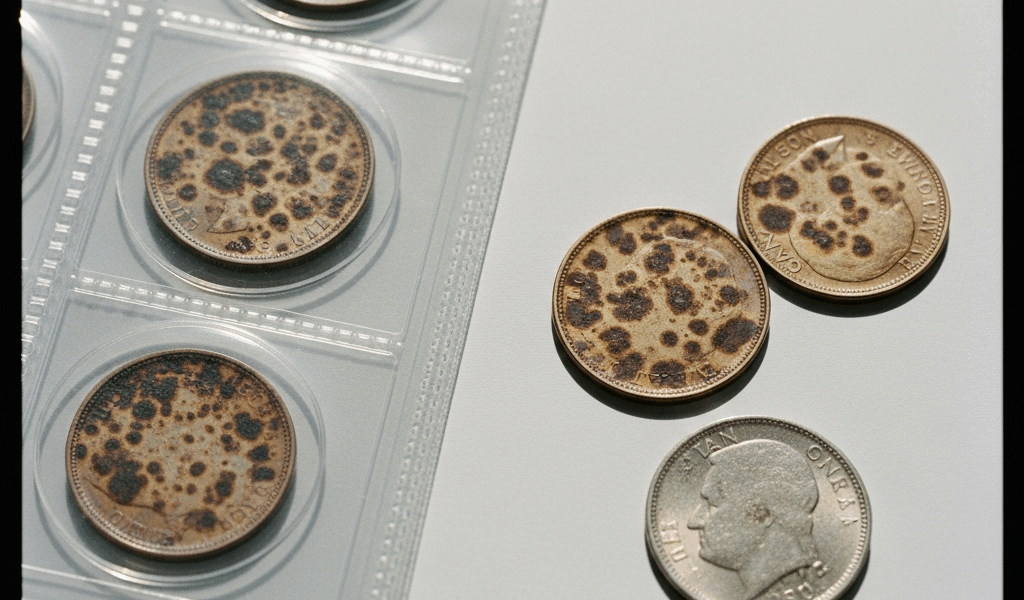
What That Staining Actually Looks Like
Coin collecting has gotten complicated with all the misinformation flying around about what’s actually destroying people’s collections. You open your album expecting to admire your coins. Instead, you find them ruined — green slime coating your copper pennies, milky white haze frosting your silver quarters, yellowish-brown toning creeping across your proof coins like a slow infection.
Most collectors panic and immediately blame themselves. Did I handle them with bare hands? Was the humidity wrong? Did I use the wrong cleaner six months ago? I’ve been there. Spent two years asking myself the exact same questions after inheriting my grandfather’s collection and watching parts of it deteriorate in front of me. Don’t make my mistake.
Stop blaming yourself. The real culprit sits right there in front of you — your coin album pages.
The green slime is the most recognizable symptom. It shows up first on copper coins: pennies, Indian heads, early cents. It looks wet even when completely dry. It smells acrid, almost chemical. Wipe it off and it comes back within days. This isn’t oxidation. This isn’t normal patina. This is something being done to your coins.
Silver coins show it differently. You get a milky or frosted appearance across the entire surface, destroying whatever mirror-bright finish you spent years carefully maintaining. Proof coins get hit hardest. That cameo contrast between the frosted design and mirror field background? Gone. Replaced by uniform cloudiness that doesn’t reverse.
Some collectors describe a yellowish or brownish toning that spreads unevenly — not following any natural aging pattern. It clusters specifically around areas where the coin touches the album page most directly. That’s your diagnostic clue right there. Natural aging doesn’t do that.
The Real Culprit Inside Your Album
As someone who inherited a grandfather’s collection and then spent two embarrassing years learning coin conservation the hard way, I learned everything there is to know about PVC damage. Today, I will share it all with you.
Most album pages are made from soft polyvinyl chloride — PVC. Cheap. Flexible. Great for holding coins snugly in place. Absolutely terrible for keeping them safe long-term.
PVC contains plasticizers. Chemical compounds added during manufacturing to keep plastic flexible rather than brittle. Over time — especially in warmer conditions or near any direct sunlight — those plasticizers break down and release gases. The primary offender is hydrogen chloride, which becomes hydrochloric acid the moment it contacts any moisture on your coin’s surface. That’s 1996-era chemistry, and manufacturers have known about it for decades.
Hydrochloric acid attacks copper aggressively. That green slime you’re looking at? That’s your coin being chemically etched in real time.
Silver responds differently. Instead of green corrosion, silver tarnishes at an accelerated rate — the acid strips away the protective oxide layer that normally forms naturally. Sulfur compounds in cheap cardboard backing sheets pile on as a second problem, bonding with silver and creating that frosted, cloudy appearance that collectors dread.
Probably should have opened with this section, honestly. It would have saved me from discovering all this only after the damage was already done to three Buffalo nickels I’ll never get back.
But what is a truly safe album material? In essence, it’s any plastic that doesn’t off-gas reactive compounds. But it’s much more than that — it’s about every component in the page, including the backing. Mylar — polyester film — doesn’t off-gas. Neither does Melinex, another polyester option. Polypropylene works fine. These cost more. They’re less flexible. They’re harder to find at your average hobby shop. So manufacturers keep defaulting to PVC because most collectors don’t notice the problem until the damage is already visible.
How to Tell If Your Album Is the Problem
You can diagnose this yourself in under ten minutes using things already in your house. So, without further ado, let’s dive in.
- The smell test. Open your album to an undamaged page and smell the plastic directly. Sharp, chemical smell — like vinyl shower curtains or cleaning products? That’s PVC off-gassing. A safe Mylar page smells like absolutely nothing.
- The touch test. Run a finger across the album page surface. Sticky or greasy despite being dry? That tackiness is plasticizer residue already migrating out of the plastic. It’s transferring to your coins every single day.
- The acetone spot test. This one requires care. Take a coin you’re genuinely willing to sacrifice — not anything valuable. Dip a cotton swab in acetone (nail polish remover from any drugstore, roughly $3 a bottle). Dab a small spot on the coin’s reverse. Wait thirty seconds. Wipe clean. Green residue on the swab means PVC compounds have already bonded to your coin. Safe pages won’t produce this reaction.
- Visual inspection of the page itself. Hold the plastic up to bright light. Milky or hazy? Clear Mylar should be genuinely transparent — like looking through nothing. Any haziness means inferior materials and elevated off-gassing risk.
Run all four tests and you’ll know your album’s status within minutes. That’s what makes this diagnostic process endearing to us collectors — you don’t need special equipment or a chemistry degree.
How to Stop the Damage Before It Gets Worse
Caught by this problem and panicking? Here’s the immediate action plan.
Step one: remove the coins. Today. Not this weekend. Not when you get around to it. The longer coins stay in contact with harmful pages, the deeper the chemical damage embeds into the surface.
Step two: air them out separately. Don’t immediately seal them into anything tight. Give them 48 hours in a clean cardboard box — nothing fancy, an old shoebox works fine — in a cool, dry spot. Let residual gases dissipate before you move to new storage.
Step three: assess the damage honestly. Green slime on copper can sometimes be addressed with careful acetone treatment using a soft brush — work slowly and test a small area first. Milky haze on silver? That’s permanent tarnish. You can polish it, but polishing changes the original surface. Proof coins lose their proof status once that happens. I’m apparently sensitive about this particular point, and losing a 1964 proof Kennedy half dollar taught me why.
Step four: source new storage immediately. While you won’t need an industrial conservation setup, you will need a handful of specific materials. Don’t return coins to any album until you’ve verified every page is genuinely safe. Mylar or Melinex pages specifically — not “archival quality” PVC, which is still PVC.
First, you should grab some Intercept Shield packaging — at least if you have higher-value pieces sitting in transition storage. Intercept Shield might be the best option for temporary holding, as coin storage during transitions requires passive gas absorption. That is because reactive sulfur and chlorine compounds in your environment don’t stop just because you removed the old album. Silica gel packets in sealed containers handle the humidity side of the equation. These aren’t magic fixes. They support the main strategy, which is permanent migration to safe materials.
Be honest with yourself about permanent damage. Tarnish doesn’t fully reverse. Surface etching from green slime leaves microscopic scarring. Those coins are compromised — learn from them and protect everything else.
Which Album Pages Are Actually Safe to Use
Safe storage options, ranked by reliability:
- Mylar pages from certified suppliers. Lighthouse brand or Intercept brand Mylar pages are the gold standard — completely inert, perfectly clear, sized for standard three-ring binders. Running about $1.50 to $2.50 per page depending on quantity. They work. Full stop.
- Melinex-based albums. Still polyester, still completely safe. Slightly less rigid than Mylar but adequate airflow between pages. Similar price point. I’m apparently fine using either interchangeably, and the Melinex works for me while cheap PVC alternatives never held up past the first year.
- Polypropylene pages from premium brands. Safe material — but verify the backing is acid-free cardboard, not sulfur-containing stock. Dansco uses polypropylene throughout most of their line. Reasonable option if you source carefully and confirm the backing specs.
- Capsules and hard slabs. Zero contact between coin and any storage material. Expensive at scale — impractical for large collections. Appropriate for high-value pieces where the cost makes sense.
Avoid any album that doesn’t explicitly state the page material on the packaging. Avoid anything labeled “soft vinyl” or “flexible PVC.” Don’t gamble on unmarked albums from unknown manufacturers at flea markets or generic online retailers.
Your action today: Pull out your current albums. Smell them. Run the acetone test on one expendable coin. If you see damage, start moving valuable pieces to Mylar pages immediately — not gradually, immediately. If you don’t see damage yet, switch your storage anyway. Prevention beats recovery every single time, and recovery is sometimes simply not possible.


Stay in the loop
Get the latest collectors coin corner updates delivered to your inbox.