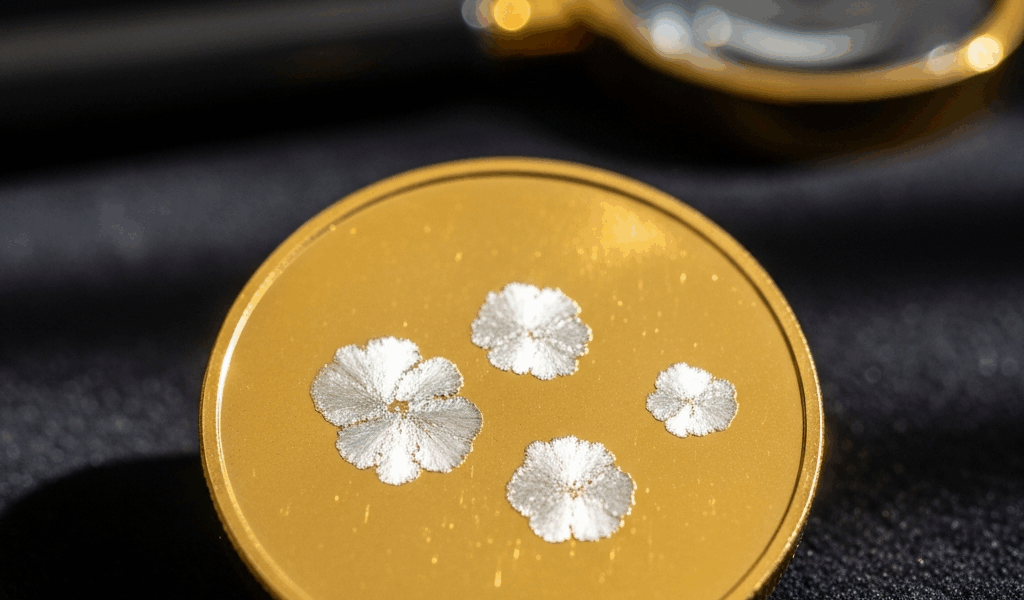
What Those White Spots on Gold Actually Are
Gold coin spotting has gotten complicated with all the misinformation flying around — especially since most spotting guides online are written for silver collectors, not gold. I found that out after panicking over a spotted Maple Leaf I’d stored practically in a vault. Turns out, I didn’t even have the right diagnosis. Today, I’ll share everything I’ve learned since then.
Here’s the thing: white spots on gold bullion coins fall into two completely separate categories. Milk spots — a minting defect baked in at the factory. And environmental spots — caused by storage conditions. That distinction changes everything. One is the mint’s fault. The other is yours, or your holder’s. They look different under magnification, they hit value differently, and the right response to one is basically the wrong response to the other.
Gold doesn’t oxidize like silver does. It’s not rust. So when spots appear, they’re telling you something specific — and reading them correctly is the only way to make a smart decision about what to do next.
Milk Spots on Modern Gold Bullion Coins
But what are milk spots, exactly? In essence, they’re a documented manufacturing defect tied to the die polishing process. But it’s much more than a minor cosmetic issue — they’re a known quality control problem that haunted the Royal Canadian Mint for well over a decade.
Here’s what happens during production. Mint technicians use chemical polishing compounds — typically sulfur-based agents — to create that mirror finish on proof surfaces and sharp detail on bullion dies. Residual compounds get trapped in microscopic surface irregularities on the die itself. When a coin gets struck using that contaminated die, those residues transfer directly to the coin’s surface. Then, over months or years — even inside a perfectly sealed holder in a climate-controlled room — those compounds interact with the gold and oxidize. The result: hazy white clusters that look almost like someone breathed on the coin and walked away.
The Royal Canadian Mint dealt with this consistently throughout the 2000s and into the 2010s. Gold Maple Leafs were the primary casualty, along with some proof gold products. I’ve personally handled coins pulled from sealed rolls — never touched, never exposed to open air — that had developed visible milk spots within two years of minting. That’s the part that frustrated collectors most. Follow every storage rule perfectly and still lose. No handling errors. No bad storage. Just bad luck with the die.
PCGS and NGC both recognize milk spots as a legitimate grading factor. Light spotting might still land a coin at MS-65 or MS-66. Heavier spotting tends to push grades down to MS-63 or MS-62. Graders note the spots in holder comments, which actually works in the owner’s favor — it establishes the defect as production-related, not collector-caused. That matters at resale.
Around 2018, the Royal Canadian Mint introduced something called Mintshield technology. It’s a protective coating applied to dies after polishing — and it significantly cut down milk spot incidents on newer Maple Leafs. Coins dated before 2018 are more susceptible. From 2019 onward, the problem is statistically rarer, though not entirely gone. Worth checking the date on your coin before drawing any conclusions.
Environmental Spots from Storage Mistakes
This is where most gold coin spotting actually starts. Gold is chemically inert compared to silver, sure — but “inert” isn’t the same as “invincible.” And the culprits are almost always boring, mundane storage materials that collectors use without a second thought.
Soft PVC flips. Those are the number-one offender, honestly. PVC off-gases plasticizers over time — the compounds that keep plastic flexible — and those gases build up inside the flip. On silver, you get green or blue patina. On gold, you tend to get brownish or white spots right at contact points, wherever the coin touches the plastic. I learned this by storing high-premium gold coins in the exact same flips I’d used for base-metal coins for years without a single problem. Wrong assumption. Don’t make my mistake.
Humidity is the second major factor. Gold doesn’t rust — but moisture mixed with trace minerals in cardboard or paper holders creates a corrosive micro-environment around the coin. Cardboard boxes, kraft paper sleeves, unsealed cardboard 2×2 holders — all of them contain sulfur compounds that can produce isolated brown or tan spots, often appearing in small clusters.
Handling oils are subtler. One ungloved contact — even a quick one during a collection inventory — can leave skin oils and trace contaminants on the surface. Those don’t always show up immediately. I’ve seen spots develop three or four months after a single handling incident. The coin looked fine in the moment. It didn’t six months later.
Silica gel is another one. A desiccant pack that breaks open, or condensation from temperature swings pulling moisture into a sealed container — those create the worst possible conditions for gold. Trapped moisture with nowhere to go. That’s when you get serious, concentrated spotting.
How to Tell Which Kind of Spotting You Have
Get a 10x loupe. That’s the diagnostic tool you actually need here — at least if you want a real answer instead of a guess.
Milk spots are hazy. Soft clusters, almost like condensation that didn’t fully evaporate. They concentrate in the open fields — the flat background areas of the design — not scattered randomly across the whole surface. On a Gold Maple Leaf, look behind the leaf and near the rim. On an American Eagle reverse, check the flat sky area. Under 10x, they appear bright white and somewhat translucent. That haziness is the tell.
Environmental spots look different. They’re often brown or tan rather than pure white. They tend to appear isolated rather than grouped. You’ll find them near the rim or at contact points — wherever the coin was touching a holder or another surface. Spots concentrated in one specific area point toward environmental causes. Spots scattered across both sides in something resembling a random pattern point toward milk spots.
If your coin is dated between 2010 and 2017, and you stored it in a proper inert holder with zero PVC exposure — milk spots are the likely diagnosis. If it was sitting in a soft flip or a cardboard box, environmental contamination is almost certainly what you’re looking at.
What You Should and Should Not Do Next
Probably should have opened with this, honestly: do not clean the coin. Not with abrasives. Not with chemicals. Not with distilled water and a microfiber cloth. Not with anything. Even so-called gentle methods remove surface material, destroy grading potential, and leave hairlines that are invisible to the naked eye but immediately obvious to a PCGS or NGC grader working at 10x. There is no cleaning method that improves a spotted coin’s grade. Zero.
If the coin has milk spots and is otherwise solid bullion quality, sending it to PCGS or NGC is worth serious consideration. Grading fees run $25–$35 per coin for standard tier submissions. What you get back is independent, documented verification that the spots are minting-related — not storage-related. That protects resale value. It prevents future disputes. And it’s the only way to establish the coin’s condition officially.
If the spotting is environmental and you’re holding a common-date bullion coin worth $60–$90 melt value, professional conservation doesn’t make economic sense. The cost of numismatic conservation — typically $50–$150 per coin at reputable services — will exceed any realistic value recovery. In that case, the better investment is fixing how you store the rest of your coins.
For storage going forward: airtite holders or certified-inert 2×2 holders — never soft PVC flips. Silica gel packets in sealed containers, replaced every six months. No cardboard. Cotton gloves for any handling. Stable room temperature, low humidity, sealed environment. Something like a small Pelican 1170 case with foam cutouts and a few desiccant packs works well for a modest collection. It costs about $30 and does the job properly.
Diagnosis first. Action second. In that order, always.



Stay in the loop
Get the latest collectors coin corner updates delivered to your inbox.