What That Green Stuff Actually Is
Coin storage has gotten complicated with all the conflicting advice flying around. Pull something beautiful out of the ground, spend an afternoon cleaning it, tuck it away carefully — and six months later it’s coated in that sickly green film you were trying to avoid. I’ve been there. A bronze Roman coin, gorgeous when I found it, absolutely ruined by the time I checked on it again.
Here’s the thing nobody tells you upfront: there are two completely different green problems. Knowing which one you’re dealing with changes everything about how you respond.
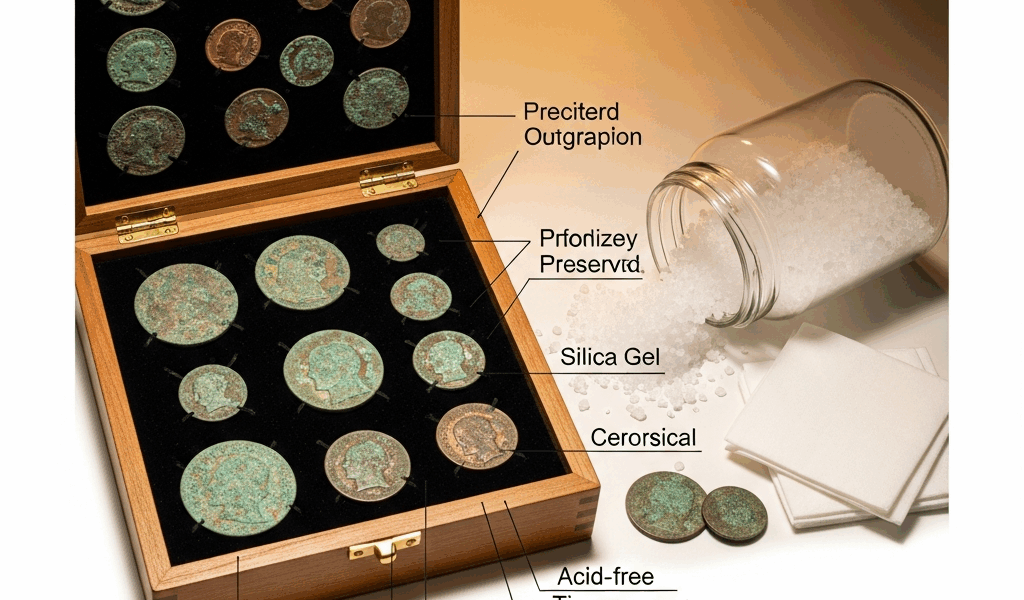
The first is patina. But what is patina? In essence, it’s a thin, stable oxide layer that forms on copper and bronze over decades or centuries. But it’s much more than that — it’s actually evidence of long-term chemical stability. Museums don’t strip it off. Serious collectors actively prize it. Hard, uniform, not flaking, not weeping? Leave it completely alone.
The second is bronze disease. That’s the one that keeps conservators up at night. Crusty nodules. Powdery deposits. A waxy green coating that looks wet even when it’s bone dry. Sometimes tiny crystalline growths appear at the edges. That’s your coin sending an SOS signal — copper chloride corrosion eating through metal from the inside out, actively spreading while you’re not looking.
Bronze disease doesn’t just look bad. It destroys the coin. Catching it at month three versus month nine can be the difference between a full recovery and a total loss. Ignored long enough, it eats actual holes through ancient artifacts. I’ve watched it happen to pieces that had survived two thousand years underground.
The Real Reasons Your Coins Are Corroding
Probably should have opened with this section, honestly. Most collectors blame the cleaning process or the soil chemistry. Wrong. The corrosion appearing now? It almost certainly started during storage.
Bronze disease needs exactly three things to flourish: chlorides (from soil or seawater exposure), moisture, and oxygen. Your job is denying it at least one. Most people are failing on all three simultaneously.
PVC Flips and Soft Plastic Holders
This is the number one storage culprit I see, without question. Those thin PVC coin flips — the stapled cardboard ones with the foggy plastic windows you can buy in bulk for almost nothing — are actively toxic to your collection. As PVC ages, it off-gases hydrogen chloride. That gas settles directly onto coin surfaces and creates exactly the chloride-rich environment bronze disease requires to thrive.
I’m apparently someone who needed three full years of watching finds degrade before connecting the dots. I used PVC flips religiously the entire time. Threw out an entire box of them the week I finally understood what was happening. Don’t make my mistake.
Ziplock Bags and Sealed Containers with Trapped Moisture
Sealing coins airtight feels protective. It isn’t — at least not if there’s any moisture present when you seal them, which there almost always is. You’ve essentially built a small greenhouse. Humidity inside climbs past 60%, sometimes pushing 80%. Coins sweat. Metal oxidizes aggressively in those conditions. Within a few months, you’ve got active corrosion on something that was stable when you found it.
Wet or Damp Coins Going Straight into Storage
This one cost me a 1943 steel cent I’d spent the better part of an afternoon recovering. Cleaned it carefully, dried it with a paper towel, sealed it in an airtight holder the same day. Sounded responsible. Wasn’t. Residual moisture — invisible but absolutely real — had nowhere to go in a sealed environment. The coin corroded within weeks. That was a $40 lesson I didn’t need to learn that way.
High Humidity Storage Spaces
Basements, attics, garages. Summer humidity in uncontrolled spaces regularly hits 70-80%. Coins are hygroscopic — they pull moisture directly from surrounding air. Add warm temperatures and you’ve accelerated every corrosion reaction significantly. Winter doesn’t fix it either. Temperature swings create condensation cycles that are, honestly, worse than sustained high humidity.
Mixed Metals and Direct Contact
Copper coins touching iron, zinc, or aluminum creates galvanic corrosion. The more reactive metal starts sacrificing itself — except it doesn’t protect anything, it pulls chlorides across the contact boundary and accelerates decay on both pieces simultaneously. Every coin needs its own compartment. At minimum, a physical barrier between different metal types.
How to Stop Bronze Disease Before It Spreads
Seeing active green corrosion right now? Isolation is step one. Remove that coin from whatever it’s stored in immediately. Don’t panic — but move fast.
For early-stage cases — slight greenish tint, minor crusty spots just developing — distilled water soaking is your first move. Distilled only, never tap water. The chlorine and mineral content in tap water actively makes things worse. Soak the coin for 24 hours in a glass or ceramic container — not metal, not plastic. Change the water three times over the first week. This isn’t cleaning. It’s chloride extraction. Stabilization is the goal, not shine.
After soaking, dry the coin completely. Lint-free paper towels first, then 48 hours minimum in a warm, dry room. No heat guns. No ovens. Thermal shock damages metal structure in ways you can’t see until it’s too late. Patient air drying works — it just requires patience.
For advanced cases — deep crusty deposits, weeping corrosion, active nodules spreading visibly — benzotriazole (BTA) is the professional-level intervention. It’s a chemical compound that halts chloride corrosion at the molecular level. A 1-5% BTA solution applied to problem areas can arrest active disease that nothing else touches. But here’s the honest part: this requires proper ventilation, careful handling, and real knowledge of what you’re doing. For coins worth under $30, the effort and risk of causing additional damage usually isn’t justified. For rare finds or anything historically significant, professional conservation makes more sense.
What not to do: don’t scrub green corrosion with brushes — you’re spreading active chlorides across clean surface area. Don’t use acetone on ancient coins. Don’t expose actively corroding coins to rapid temperature changes. Don’t seal anything back up until it’s completely, verifiably dry.
Some coins are simply too far gone. Deep pitting, sections eaten through entirely — that damage is permanent. Accept it, document what you learned, and move forward with better practices. Coins are remarkably durable objects. Your storage system needs to match that durability.
The Right Way to Store Coins Long Term
This is the system that works. Two years running now, zero corrosion incidents on anything stored correctly from day one.
First, you should replace every PVC holder immediately — at least if you want your collection intact in five years. Mylar flips are the safe alternative. Chemically inert, no off-gassing, widely available. Inert hard plastic capsules work even better — polypropylene or polyester specifically, never PVC. Lighthouse and Intercept-Shield both make solid 2×2 holders at roughly $0.20 each in bulk. That price is genuinely not worth skimping on.
Second: silica gel in every sealed container. One small packet absorbs ambient moisture and holds relative humidity below 40% consistently. Replace them every 6-12 months depending on your local climate. A 10-pack runs $2-5. Cheapest insurance available for this hobby.
Third: get a hygrometer. Around $15 on Amazon — the ThermoPro TP49 is what I use, and it’s accurate enough for this purpose. If your storage space is running above 50% humidity consistently, move coins to a climate-controlled closet or add a small dehumidifier. Knowing your actual numbers matters more than guessing.
Fourth: label everything. Mylar flip, small paper label, quick description and find location. You’ll thank yourself later — probably sooner than you expect.
Fifth: never seal wet coins. Ever. Complete, verified dryness first. Always. No exceptions.
When to Get a Corroded Coin Professionally Conserved
Real talk: not every corroded coin deserves professional attention. Common finds worth $2-10? DIY stabilization and better storage going forward is your answer. That’s the honest calculation.
Rare coins, historically significant pieces, anything over $50 in value — professional conservation makes genuine sense. NGC and PCGS both offer conservation services. They stabilize active corrosion, extract harmful chlorides chemically, and address future degradation at a level home methods can’t match. Pricing runs $20-50 per coin depending on severity and services. For valuable pieces, that’s worth every cent.
That’s what makes this hobby endearing to us collectors — every mistake becomes permanent knowledge. You’ve learned the hard way, which means you’ve actually learned it. Your future finds get stored correctly from day one. The coins you caught early will stabilize. The storage system you’re implementing now works. Move forward with that.



Stay in the loop
Get the latest collectors coin corner updates delivered to your inbox.