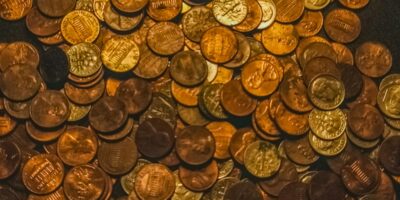

Wheat pennies are the most common valuable find for metal detectorists. Minted from 1909 to 1958, these Lincoln cents with wheat stalks on the reverse turn up regularly in parks, yards, and old homesteads. Most are worth a few cents—but the right date can be worth hundreds or even thousands.
Here’s your complete guide to wheat penny values, with a focus on what you’ll actually find in the ground.
Quick Value Guide: What’s Your Wheat Penny Worth?
Common Dates (Most of What You’ll Find)
| Condition | Value |
|---|---|
| Poor/Worn (typical dug condition) | $0.03-0.05 |
| Good (readable date) | $0.05-0.10 |
| Fine (some detail visible) | $0.10-0.25 |
| Very Fine+ | $0.25-1.00+ |
Key Dates: The Wheat Pennies Worth Real Money

The Big Three ($100+)
| Date | Mintage | Value (Good) | Value (Fine) |
|---|---|---|---|
| 1909-S VDB | 484,000 | $800+ | $1,200+ |
| 1914-D | 1,193,000 | $250+ | $500+ |
| 1922 No D | Unknown | $600+ | $1,000+ |
Semi-Key Dates ($10-$100)
| Date | Value (Good) | Notes |
|---|---|---|
| 1909-S | $100+ | Without VDB initials |
| 1909 VDB | $15+ | Philadelphia mint (no mint mark) |
| 1911-S | $35+ | Low mintage |
| 1912-S | $25+ | Low mintage |
| 1913-S | $15+ | Low mintage |
| 1914-S | $25+ | Low mintage |
| 1915-S | $20+ | Low mintage |
| 1922-D (Weak D) | $25+ | D barely visible |
| 1924-D | $35+ | Low mintage |
| 1926-S | $10+ | Low mintage |
| 1931-S | $100+ | Depression-era rarity |
| 1933-D | $4+ | Low mintage |
The Error Coins (Potential Jackpots)
| Error | Value | How to Identify |
|---|---|---|
| 1943 Bronze | $100,000+ | Copper color (should be steel) |
| 1944 Steel | $75,000+ | Steel color (should be copper) |
| 1955 DDO | $1,000-$50,000 | Obvious doubling on date and lettering |
| 1958 DDO | $300+ | Doubling on “IN GOD WE TRUST” |
| 1922 No D | $600+ | 1922 with no mint mark (Strong Reverse) |
How to Check Your Wheat Pennies
Step 1: Check the Date
Use a magnifying glass if needed. Dates from 1909-1915 and 1920s are most likely to be valuable.
Step 2: Check for Mint Mark
Look below the date on the obverse (front):
- No mint mark: Philadelphia (most common)
- D: Denver
- S: San Francisco (often more valuable)
Step 3: Check for Errors
- 1943: Use a magnet. Real 1943 steel cents stick to magnets. If it doesn’t stick and looks copper, you might have a $100,000 coin.
- 1955: Look for doubled letters on “LIBERTY” and “IN GOD WE TRUST”
- 1922: Look carefully for any trace of “D”—a true “No D” has no D whatsoever
Year-by-Year Value Chart
1909-1919 (Early Years)
Generally worth $0.50-$5+ in average condition. Watch for S mint marks.
1920-1929 (Roaring Twenties)
$0.10-$2 typical. 1922 No D and 1924-D are key dates.
1930-1939 (Depression Era)
$0.05-$1 typical. 1931-S is the big one. 1933-D also semi-key.
1940-1958 (Final Years)
$0.03-$0.50 typical. 1943 steel cents interesting. 1955 DDO is valuable. 1958 is the last year.
What Affects Value
Condition Grades
- Good (G): Date visible, heavily worn
- Very Good (VG): Some wheat stalk detail visible
- Fine (F): Moderate wear, details visible
- Very Fine (VF): Light wear on high points
- Extremely Fine (EF): Slight wear only
- About Uncirculated (AU): Minimal wear
- Uncirculated (MS): No wear (rare from ground)
Color (For Uncirculated)
- Red (RD): Original copper color—most valuable
- Red-Brown (RB): Partial original color
- Brown (BN): Fully toned—least valuable for uncirculated
What to Do With Your Wheaties
Valuable Finds (Key/Semi-Key Dates)
- Don’t clean—ever
- Store in protective holder
- Get professionally graded if worth $50+
- PCGS or NGC are the trusted services
Common Dates
- Save them in a jar or album
- Sell in bulk when you have enough (5-10 cents each)
- Give to young collectors to spark interest
- Keep the nice ones for your personal collection
Where to Sell Wheat Pennies
- Key dates: Auction houses, major coin dealers
- Semi-keys: Local coin shops, eBay
- Common dates in bulk: Coin shops pay 3-5 cents each; eBay lots
Found a key date? Share your story in the comments!