What Is Actually Happening to Your Slab
Coin slab storage has gotten complicated with all the conflicting advice flying around. So let me just tell you what’s actually happening to your case — because once you see it, you can’t unsee it.
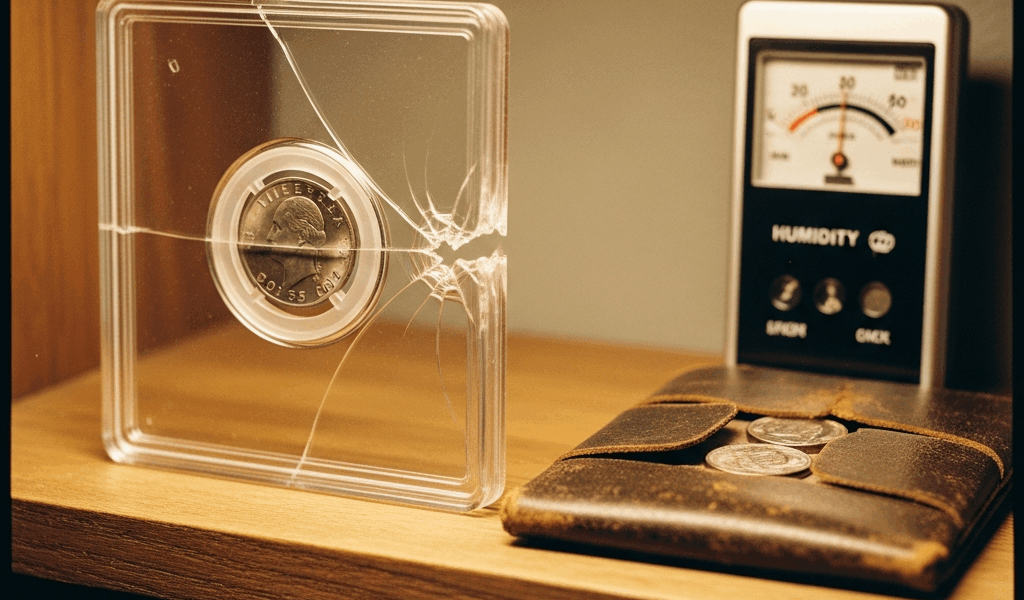
Your coin holder is cracking your slab. I know that sounds dramatic. It’s not. It’s the most straightforward explanation for those hairline fractures and stress marks showing up along the edges of your graded coins.
Probably should have opened with this section, honestly. Most collectors don’t catch this damage until weeks or months in, and by then, the diagnosis gets genuinely messy.
The damage shows up in three ways. Hairline cracks first — thin, almost invisible unless you tilt the case at an angle under decent light. Then stress fractures, usually concentrated along the bottom edge or corners where pressure builds. And sometimes clouding, a milky film spreading across the interior of the acrylic itself. That last one looks like condensation. It isn’t.
Root causes come down to two things. Either nearby holder materials are off-gassing chemicals directly onto your slab case — slow, invisible, relentless — or physical pressure from bad storage is literally flexing the case until it fractures. Often it’s both at once. That’s why the problem sticks around even after you’ve shuffled things around a few times.
The Holder Materials Most Likely to Blame
Soft PVC flips are the primary culprit. These are the thin, floppy coin holders — roughly $0.10 each, feel slightly slippery, found in virtually every bulk collection. They look harmless. They’re not. PVC releases plasticizers, specifically dibutyl phthalate and similar compounds, especially when temperatures climb. Store these within a few inches of your slabs and the off-gassing migrates directly onto the case surface and into the acrylic itself.
Non-archival cardboard 2×2 flips cause the same problem from a different angle. Generic bulk cardboard — the kind you find in older collections or inherited lots — degrades over time and releases volatile organic compounds. Here’s a quick test: open the storage box and actually smell it. Vinegary? Sweet? Chemically off in any way? That’s your answer right there.
Rubber bands wrapped around slab bundles are sneakier. I’m apparently someone who thought bundling a stack of early-2000s PCGS slabs with rubber bands was protective. It wasn’t. Within six months I had visible compression marks at the case edges where the bands had concentrated pressure. Don’t make my mistake.
Foam inserts deserve a mention too — the packing foam that comes in shipping boxes or that some collectors tuck under their stacks. Polyurethane foam off-gasses aggressively, especially after sitting in a warm storage space for any length of time. Pull it out. Keep it out.
Here’s a practical test you can do right now. Take your slab out of wherever it lives. Look for discoloration, filming, or fine dust accumulation on the case surface. Run a finger over it gently. Does it feel slightly greasy? Does a dry tissue pick up any residue when you wipe it? That residue is off-gassing already penetrating the acrylic. Not a future problem — a current one.
How Storage Conditions Make It Worse
Temperature and humidity act as accelerants. A garage hitting 85°F in July or a car interior baking at 110°F will off-gas PVC and foam at double or triple the rate of a climate-controlled room. Humidity compounds it — moisture helps acrylic absorb and retain those off-gassed chemicals more readily. The combination is genuinely brutal on cases.
Temperature cycling is the silent cracker. Acrylic expands and contracts microscopically with every temperature swing. Sixty-eight degrees one day, fifty-two the next. That differential stress, repeated over weeks, creates micro-fractures that eventually become visible cracks. I’ve seen this wipe out entire collections stored in poorly insulated basements. Attics are even worse.
Humidity fluctuation amplifies everything. High humidity makes acrylic slightly more pliable. Low humidity makes it brittle. Swinging between the two puts the case in constant mechanical stress — even when nothing physical is touching it.
Step-by-Step Check to Find the Source
So, without further ado, let’s dive in. Here’s how to actually diagnose your specific problem.
- Remove and isolate. Pull every suspect slab out of its current storage location. Separate it from all nearby holders, cardboard, foam, and plastic materials. Move each one to a clean, open shelf or table. This breaks the exposure chain and lets you actually see the damage clearly — without the context of whatever was causing it.
- Inspect the case surface. Check both the front and back acrylic for residue, clouding, or film. Use a microfiber cloth and wipe gently. Does anything transfer? Greasy residue on the cloth is chemical off-gassing, full stop. Pay special attention to edges and seams — that’s where airflow is poorest and accumulation is worst.
- Examine your storage boxes. What’s lining the interior? Cardboard, foam, plastic, something unidentified? If you genuinely can’t tell what it is, that’s already a red flag. Pull any foam inserts permanently. Open the box, put your nose close to the interior, and take a real sniff. You’ll know if something is wrong.
- Evaluate airflow and humidity. Was the slab in a sealed plastic bin? Enclosed closet shelving? A garage corner with no air movement? Grab a basic humidity meter — they run $8 to $15 on Amazon, and the AcuRite 00613 works fine — and measure the actual humidity at that storage spot. Above 60% relative humidity is problematic. Below 30% is also problematic. You want 40–50% and you want it consistent.
- Cross-reference the damage location. Where exactly is the crack or clouding? Bottom edge? Top corner? Along one specific side? Now think hard about what was touching or closest to that exact spot in storage. A PVC flip stacked directly against that face? Foam pressing into that corner? A rubber band wrapped around that zone? The damage location almost always points straight at the source — at least if you know what to look for.
How to Store Slabs Safely Going Forward
But what is a truly safe slab storage material? In essence, it’s anything inert — chemically stable, non-reactive, and free of plasticizers. But it’s much more than that. It also means thinking about pressure, airflow, and climate all at once.
Polystyrene holders might be the best option, as slab storage requires chemical inertness above everything else. That is because polystyrene doesn’t off-gas, doesn’t flex under normal conditions, and plays nicely with acrylic cases long-term. Mylar flips are also safe — archival-grade, transparent, and stable. While you won’t need a climate-controlled museum vault, you will need a handful of the right materials and one decent humidity meter.
First, you should swap out any PVC or unidentified plastic holders immediately — at least if you want to stop the damage rather than just slow it. Archival cardboard 2x2s are acceptable, but only if the packaging explicitly says acid-free and acid-buffered. Generic cardboard is not acceptable. That label matters.
Stack slabs vertically whenever you can rather than horizontally. Vertical stacking distributes weight evenly across the case and prevents pressure from concentrating at the edges. If horizontal stacking is unavoidable, keep it to five or six slabs deep maximum. The weight of the upper cases will flex the lower ones — slowly, invisibly, and eventually permanently.
Open shelving beats sealed containers. Air circulation prevents chemical accumulation around the cases. A living room bookshelf beats a closet. A closet beats a basement. A basement beats a garage. If you need to use a storage box, make sure the interior lining is acid-free and the box itself allows some airflow. Temperature consistency and humidity control matter more than darkness. Slabs don’t fade — they’re already graded.
That’s what makes proper slab storage so important to us collectors. These aren’t just plastic cases. They represent real money and sometimes real history. This isn’t complicated once you see the full picture. The problem was never mysterious — just something nobody explained clearly until you actually needed the answer.



Stay in the loop
Get the latest collectors coin corner updates delivered to your inbox.